Key findings
Companies step up access planning for pipeline products, but progress lags for non-communicable diseases
10 November 2026
More companies are planning how their products will reach patients before launch, with access plans now covering 69% of late-stage pipeline candidates – more than triple the share in 2018; however, progress remains uneven, especially for some non-communicable diseases (NCDs).
Cancer products continue to dominate pharmaceutical R&D, accounting for around half of all clinical candidates. Access strategies for these products are beginning to extend beyond high-income markets, while some companies are also addressing broader barriers to cancer treatment.
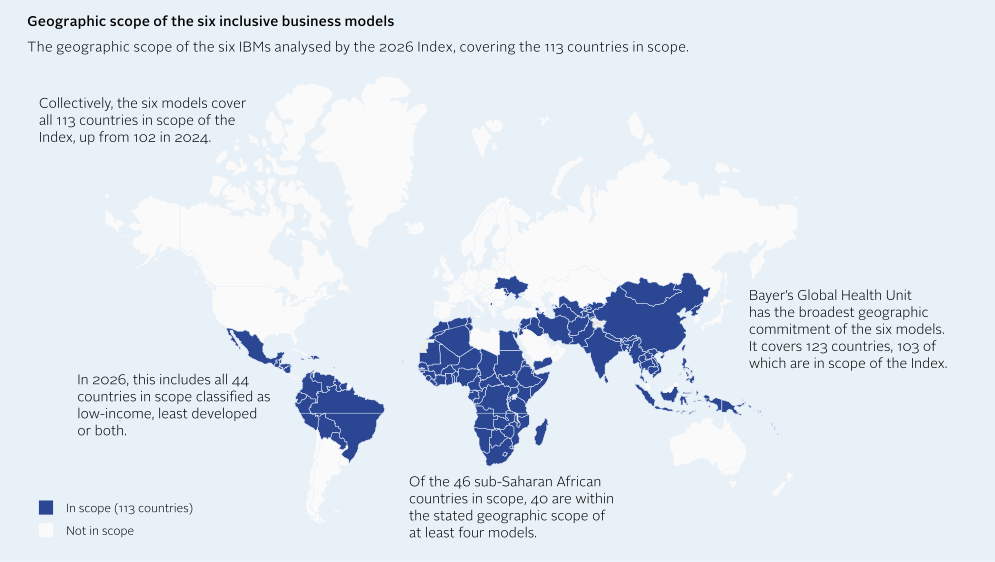
Six companies now operate inclusive business models, up from five in 2024, collectively spanning all 113 LMICs in scope. While most companies report growing patient reach, limited granular reporting makes it difficult to assess impact.
GLP-1s make up the bulk of the diabetes research pipeline. Yet access to these products remains limited in LMICs, while even long-established insulin remains out of reach for many despite the high burden of diabetes in these settings.
Novartis takes the top spot for the second time, closely followed by GSK, and takes the lead in every area assessed in the Index.

This year's Index looks back at two decades of change in how companies approach access to medicine – and how the industry has evolved with it. Charting this shift alongside the evolution of the Index itself, the analysis reveals a clear and promising transformation: access has moved from the fringes of company operations, becoming a more integral part of how they do business.
But change isn’t happening fast enough for those who need it. Funding constraints, geopolitical instability and rising health needs are putting growing pressure on the global health ecosystem. Against this backdrop, persistent gaps in lower-resource settings and in care for some critical diseases risk leaving many of the world’s most vulnerable populations behind.
This Index looks beyond where progress has been made to what it will take to extend its reach. Its analysis highlights opportunities for companies and other global health actors to build on momentum and close persistent gaps, ensuring access catches up with innovation and sustainable, long-term approaches for global health equity take root.
Encouragingly, access is increasingly being considered earlier in product development, giving companies more opportunity to anticipate and address the barriers patients may face once a medicine is launched. But the scope of these plans varies considerably. Six promising late-stage medicines illustrate this: while all have access plans, these differ in how comprehensively they address availability, affordability and supply. For NCD products, 43% of plans focus solely on registration rather than addressing wider barriers to access.
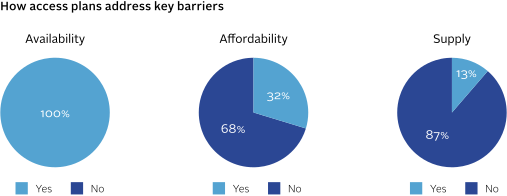
Companies now need to build on the progress made in access planning, which has more than tripled since 2018, by making it systematic across pipelines and more responsive to local needs. Working with partners in LMICs can help companies anticipate barriers and develop plans that go beyond regulatory approval to address other factors that determine whether products ultimately reach patients.
With cancer so prominent in pharmaceutical R&D, it is promising that access plans now cover 65% of oncology pipeline candidates. Access efforts are also extending into lower-resource settings, with strategies identified for 74% of assessed cancer products in lower-middle-income countries and 19% in low-income countries. Companies including AstraZeneca, Bristol Myers Squibb and Roche also stand out for efforts that address wider barriers patients face along the cancer care pathway, beyond access to medicine itself.
The next step is to build on these approaches so that access can better keep pace with innovation. Working with established cancer programmes and treatment centres in LMICs can help companies address gaps across the patient pathway – from screening and diagnosis to affordability and healthcare capacity – and strengthen approaches that can be sustained and scaled to reach more patients.
Six companies now operate multi-country inclusive business models designed to reach underserved populations, collectively spanning all 113 LMICs in scope of the Index. Most companies report growing patient reach, while companies are also developing partnerships and taking a longer-term approach to sustaining these models. However, progress varies, and limited product-level reporting makes it difficult to assess who is being reached, with which products and where.
Companies now need to deepen these models in lower-income countries, working with local partners to adapt them to different contexts while embedding financial sustainability. More transparent reporting on patient reach at the product and country level will also be critical to understanding whether these models are truly delivering on access goals.
The Index finds 25 R&D projects in diabetes across six companies, with innovation heavily concentrated on GLP-1 medicines. Meanwhile, Lilly, Novo Nordisk and Sanofi are taking steps to expand access to insulin, but significant gaps remain, particularly in lower-income countries.
Expanding affordable and reliable access to insulin must be a key priority for global health actors, while ensuring newer diabetes treatments and technologies do not widen existing inequalities. This will require stronger delivery models, partnerships and measurable commitments to expand access.
Novartis (1st) and GSK (2nd) stand out for their performance, holding these same ranks in all three Technical Areas: Governance of Access, R&D and Product Delivery. These two companies sit clearly ahead of the six high-performing companies that follow, all of which score above average across these areas, including AstraZeneca (3rd), Sanofi (4th), Bayer (5th) Boehringer Ingelheim (6th), Roche (6th) and Pfizer (8th).
Changes to how the 2026 Index assesses companies have sharpened the differentiation of company performance. With fewer indicators and greater emphasis on implementation and measurable outcomes, the 2026 Index places greater weight on where companies are demonstrating meaningful progress in practice.

A retrospective examining ten editions of the Access to Medicine Index spanning two decades of data, exploring the progress companies have made in expanding access to medicine.
Key Findings: Three essential takeaways from the 2026 Index, spotlighting lagging access planning for NCDs, persistent gaps in cancer care and challenges faced by companies’ inclusive business models.
Ranking and Industry trends: How companies score and compare, and industry-wide trends.
Best Practices: An in-depth look at what companies are doing right, with key examples for others to follow.
Thematic Analyses: A detailed look at key themes emerging from the research, including research and development, patient reach, access planning, partnerships, and a special spotlight on diabetes.
Company Report Cards: A detailed overview of each of the 20 companies’ performances, alongside areas for improvement.
To accelerate progress towards global health equity, companies must ensure their strategies for access build on what's been proven to work and close the gap between medical innovation and patient need.
Using the recommendations set out in the 2026 Access to Medicine Index, as well as the tailored "Opportunities" highlighted for each company in its respective Report Card, companies are encouraged to take decisive action to accelerate their efforts and work towards closing persistent access gaps.
* 2026 Access to Medicine Index period of analysis: 1 June 2024 to 31 May 2026
