Featured
Key findings
Promising pockets of progress emerge in cancer access, but the overall picture remains uneven
10 November 2026
10 November 2026
Six companies now operate multi-country inclusive business models (IBMs) designed to reach underserved populations, up from five in 2024. Collectively, these models span all 113 low- and middle-income countries (LMICs) in scope of the Index.
Most companies report growing patient reach, but progress varies across models, and the lack of product-level reporting makes it difficult to assess impact.
Companies are deepening and developing new partnerships to adapt and expand their models across different markets.
Companies are increasingly taking a deliberate, long-term approach to access in LMICs, with all six demonstrating long-term market planning and pathways towards financial sustainability, and three further embedding IBM access goals within executive accountability.
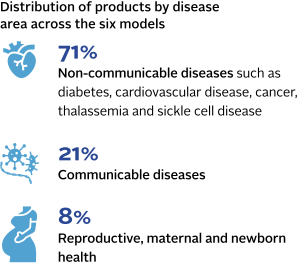
Pharmaceutical companies are increasingly implementing business models designed to reach patients often overlooked by traditional models. The 2024 Access to Medicine Index identified five companies with multi-country models aimed at reaching underserved or unserved populations in LMICs. By 2026, that number has increased to six, with Bayer's Global Health Unit (GHU) joining those of Bristol Myers Squibb, Novartis, Novo Nordisk, Pfizer and Sanofi (see timeline below). Together, the six models now cover 113 LMICs, including all 44 low-income countries and/or least developed countries in scope of the Index. They also span a broad range of disease areas, with over two-thirds of products focused on non-communicable diseases (NCDs).
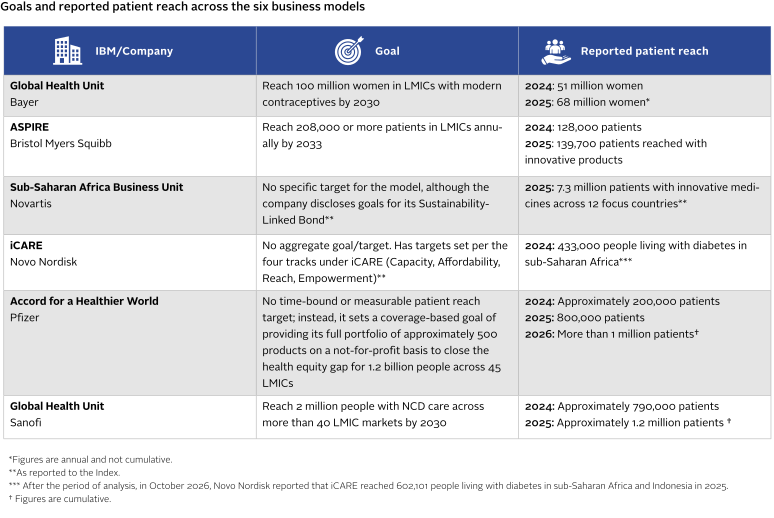
Overall, there are signs of progress in both the number of patients these models are reaching and how they are being implemented – from partnerships and financial sustainability to their integration into corporate governance and executive accountability structures. However, the extent of progress varies between companies, and more detailed reporting is needed to understand their impact and whether they are delivering on commitments.
Companies report growing patient reach across their IBMs. However, progress in closing the access gap for their target populations varies considerably, in part reflecting different stages of implementation.
As these models develop, consistent reporting on outcomes will be essential to evaluate whether they are translating into greater patient reach and delivering against the access goals set for them. Given the scale of unmet need across LMICs, this continued assessment of where progress is being made – and where gaps remain – will be critical to refining these models and extending their reach.
Sanofi stands out in this regard for its transparent reporting on the progress of its Global Health Unit, being the only company that publicly reports country-level information on patient reach, activities, initiatives and partnerships. Across the board, however, reporting at the product level remains limited. Companies do not consistently disclose how many patients each product reaches or the outcomes achieved, limiting visibility into the impact these models are having.
Two years on from when the Index first reported on it, there has been progress in how these models are implemented, especially through companies adapting or deepening the partnerships that underpin them. These partnerships span governments, institutions, academic organisations and NGOs, and are critical to how models are delivered in different country contexts.
Across most of the six models, companies are signing more agreements, bringing in new partners and expanding existing collaborations. Selected developments illustrate the different ways in which partnerships are evolving across the models. For some companies, expanded partnerships are helping bring existing models within reach of more patients. Bristol Myers Squibb, Pfizer and Sanofi have extended their models to more countries through additional country agreements. This allows patients in these new countries to gain access to models that are already tested elsewhere, refined through experience and adapted to fit local conditions.
Others are using partnerships to tailor implementation more closely to local health systems, supply chains and policy environments. Bayer, for example, is partnering to localise the manufacturing of some essential medicines in Egypt, while Novo Nordisk has adapted iCARE for implementation through Indonesia's universal health coverage system.1 By aligning implementation with local systems and infrastructure, these partnerships have the potential to support more sustainable access and make medicines easier for patients to obtain through the way healthcare is already delivered.
Collectively, partnerships are also becoming more diverse, reflecting the different capabilities needed to implement IBMs across settings. Rather than relying on a single type of partner, companies are engaging governments, manufacturers and healthcare organisations depending on local implementation needs. This suggests a shift from partnerships as a delivery mechanism to more strategic, locally tailored relationships that help companies adapt and scale their models across different settings.
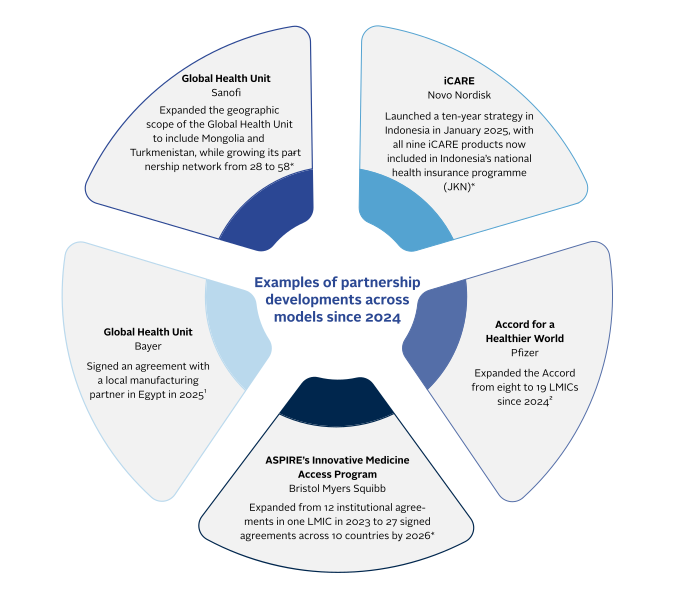
NOTE: The figure represents selected examples of partnership developments identified by the Index and is not intended to provide a comprehensive overview across all six models.
The Index finds that companies are taking a deliberate, market research-driven approach to entering and establishing a long-term presence for their IBMs across markets. All companies provided evidence of having a long-term strategy in place, typically spanning at least five and up to ten years. These strategies normally outline which products they plan to introduce in different countries, the timelines for doing so, and the most appropriate approach, or combination of approaches, to use in each market. This long-term planning provides a foundation for companies to work towards the financial sustainability of their models.
All companies shared, albeit in varying levels of depth and detail, how their models are currently financed and how they plan to finance expansion into new geographies or the addition of new products. Notably, none of the models rely on donor or philanthropic funding. This reduces their exposure to shifts in global health funding priorities and can help support continuity of access for patients who rely on them.
The financial structures underpinning these models vary. In some cases, companies provide an initial upfront investment and have established internal timelines or milestones by which the model is expected to become cost-covering or self-sustaining. Across the models assessed, the Index also identified several mechanisms intended to contribute to longer-term financial sustainability.
These mechanisms are not static. Companies learn as they implement their models and adapt their approach for particular products or countries when plans do not develop as expected. Rather than following a single blueprint, companies are tailoring their approaches to different products, markets and health system contexts, reflecting the different commercial and implementation realities in which they operate.
Overall, these findings show how companies are seeking to build longer-term financial foundations for their models. While the pathways differ across companies and markets, companies are considering both how their models are financed today and how their continued operation and expansion can be supported over time. As companies continue to implement and scale their models, establishing a stable financial foundation will be important for maintaining affordable access and continuity of supply for patients. However, it is important to note that companies cannot rely on their own resources alone, but must increasingly explore embedded financing mechanisms and shared ownership with governments, payers and other local stakeholders.
Three companies, Bayer, Bristol Myers Squibb and Sanofi, more explicitly incorporate targets associated with their models into executive performance indicators or compensation, creating a clearer link between leadership incentives and the objectives of these models. This indicates that these models are being treated as strategic business priorities, with defined leadership accountability for their performance.
At Sanofi, part of the CEO's short- and long-term incentive compensation is tied to objectives related to the Global Health Unit, while Bayer reports folding access goals — including its "100 million women" commitment linked to the Global Health Unit— into long-term executive incentives. Bristol Myers Squibb, meanwhile, includes ASPIRE within its Sustainability & Social Impact scorecard, which feeds into annual executive incentives.
Other companies also incorporate access and sustainability objectives into executive incentive structures, although the connection to specific models is less direct. While this signals that access is becoming a broader leadership priority, it provides less direct accountability for the implementation and performance of individual models.
These models offer a way to reach populations often overlooked by traditional business models, including in countries where disease burdens are high and unmet needs remain significant.
The six models profiled here show what this can look like in practice. As they continue to mature, maintaining momentum – by extending patient reach, refining implementation and strengthening accountability for results – will be important to delivering on the commitments made to the patients they are designed to serve. Companies can also learn from one another and use the recommendations below to build on progress and strengthen their models over time.
Expand and deepen implementation of IBMs in lower-income countries, working with local partners to adapt to country contexts and ensure long-term access.
Continually embed financial sustainability into the design of IBMs, ensuring that financing mechanisms both sustain operations and enable expansion into new geographies and products, while remaining affordable for the populations served.
Build on existing progress in tracking the outcomes of these models by reporting how many patients are being reached, with which products and in which countries, enabling more transparent assessment of whether these models are reaching their intended access goals and targets.
Strengthen the institutional governance, accountability and ownership of IBMs by aligning executive incentives more directly with the implementation and performance of these models.
*As reported to the Index and/or based on the assessment by the Index during period of analysis