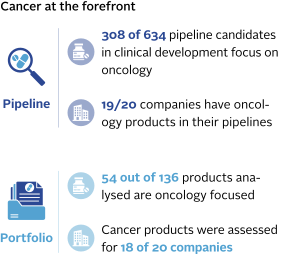
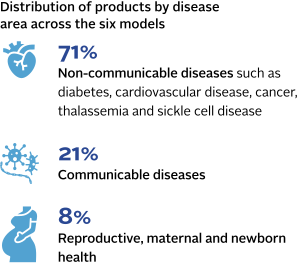
Cancer is a leading focus of the pharmaceutical industry. Almost half of all clinical candidates in development target oncology, and nearly all companies in scope have oncology projects in their research and development (R&D) pipelines (see graphic). Cancer medicines also account for 40% of the marketed products selected for analysis* in the Index – the largest share of any disease area.
* Product selection prioritised innovative, on-patent treatments with clinical importance and relevance to global health priorities.
Alongside this investment, some companies are going beyond making their products available by addressing other needs of cancer patients, such as diagnosis, health worker training and patient support. There are also signs of access efforts extending further into lower-resource settings. However, significant gaps remain in terms of where – and how – patients can access cancer treatments.
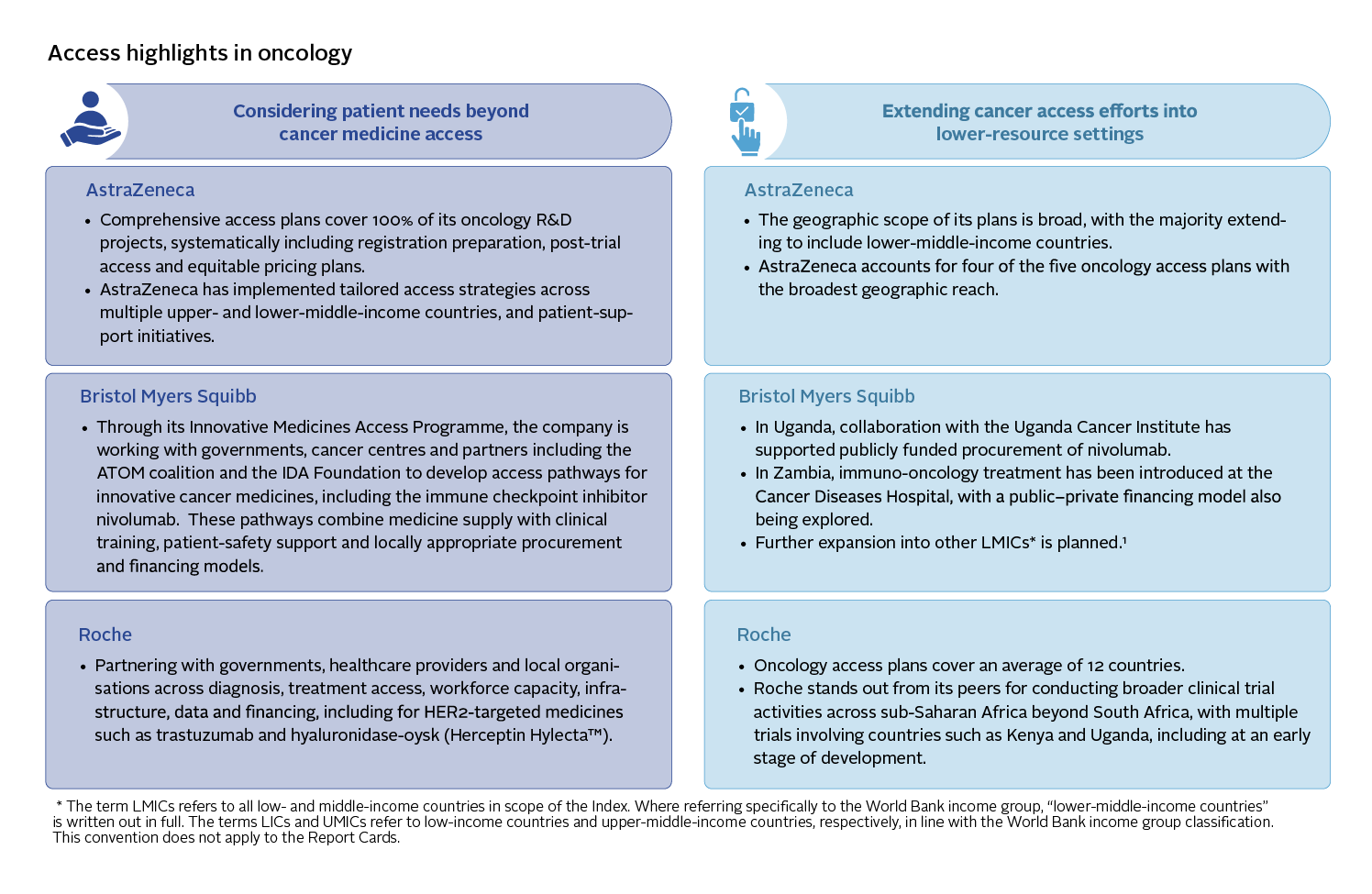
AstraZeneca, Bristol Myers Squibb and Roche demonstrate efforts to address needs beyond cancer medicine access
Making a medicine more widely available in a country generally requires that it is registered there. Other routes – such as import waivers, named-patient programmes and post-trial access – can provide access in specific circumstances but typically reach a more limited group of patients. However, even after a cancer medicine is made available, patients may still face significant barriers to actually accessing treatment due to affordability constraints and health system limitations.
For oncology, AstraZeneca, Bristol Myers Squibb and Roche stand out for having some of the strongest access strategies and/or plans, with progress in addressing wider health-system barriers along the patient pathway beyond product access. Their plans and strategies extend to other stages of the cancer continuum of care – the sequence of health services a patient may need throughout their cancer journey – supporting areas such as diagnosis and testing, healthcare-worker training and patient support.
AstraZeneca is applying this broader approach while products are still in development. The company has comprehensive access plans for all of its oncology R&D candidates, systematically including accessibility and affordability measures. For example, its access plans apply a structured framework for regulatory submission that considers a broad range of countries – including different lower-middle-income countries – from an early stage. Additionally, some plans consider diagnostic accessibility, a key element for oncology access in low- and middle-income countries (LMICs). Considering these wider needs during development gives companies more time to prepare for what may be needed alongside the medicine once it is approved.
For products already on the market, more companies are taking these needs into account: approximately 66% of oncology access strategies are accompanied by initiatives that strengthen health systems across various stages of the cancer care continuum.
AstraZeneca has implemented tailored access strategies across upper-middle-income countries (UMICs) and lower-middle-income countries that address barriers beyond affordability, including diagnosis and patient support. Meanwhile, Roche is strengthening care pathways for HER2-targeted medicines, which can be used to treat certain sub-types of breast cancer.
For its immuno-oncology medicines, which can require specialist expertise to administer and manage, Bristol Myers Squibb combines medicine access with clinical training and patient-safety support, alongside locally adapted procurement and financing to improve availability and affordability. Together, these measures address several of the challenges involved in making these complex treatments available and ensuring patients can receive them safely and effectively in different settings.
Companies are planning for access earlier, but geographic coverage remains concentrated
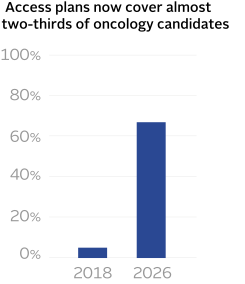
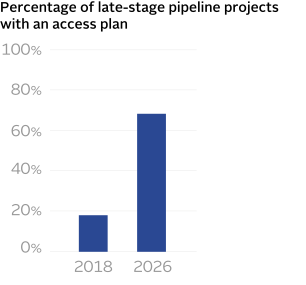
Beyond what individual access efforts cover, there has also been a shift in when companies start planning for access to their cancer products. While early access planning for non-communicable diseases lags on the whole, cancer shows signs of improvement: the proportion of pipeline cancer candidates covered by an access plan has risen substantially since the Index first measured this in 2018.
The geographic reach of these plans, however, remains relatively narrow. They cover an average of just five countries and are largely concentrated in commercially promising UMICs and emerging markets. Roche stands out, with its access plans covering an average of 12 countries – more than twice the industry average – with its plans extending to lower-middle-income countries and one LIC.
Promising steps to expand the availability of cancer products in lower-resource settings
There are some encouraging signs of efforts to extend into lower-resource settings, demonstrating that companies can expand their reach despite persistent infrastructure and health-system challenges. Roche, for example, is conducting oncology clinical trials in Kenya and Uganda, helping to generate evidence in a region historically underrepresented in cancer research.
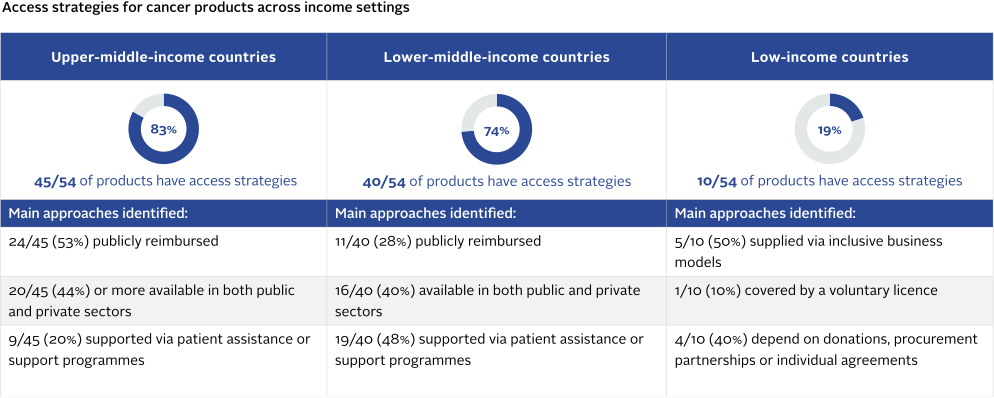
Progress is also visible for products already on the market. Access strategies were identified for 74% of assessed cancer products in lower-middle-income countries and 19% in LICs, with six new approaches targeting LICs reported this cycle. Most of these new approaches are still under development or at an early stage, although one from Roche has progressed to supplying medicines and reaching patients in The Democratic Republic of the Congo. Roche has also signed a memorandum of understanding with the country’s National Institute of Public Health that includes large-scale HPV and breast cancer screening.2
Bristol Myers Squibb illustrates efforts to extend access strategies into lower-middle income countries and LIC markets. The company is expanding access to immuno-oncology treatment in Uganda (LIC) and Zambia (lower-middle-income country), including publicly financed access to nivolumab at the Uganda Cancer Institute and access through a public–private partnership at Zambia’s Cancer Diseases Hospital.1 Its approach highlights the role of collaboration in implementing access strategies, working with local health systems and partners to build sustainable access pathways that can be expanded to additional LMICs.
Further opportunity to broaden access and strengthen pathways
There is significant opportunity to build on these developments and reach more patients in lower-resource settings. This means not only extending access strategies to more products and countries but also strengthening the routes through which patients can access treatment.
In lower-middle-income countries and LICs, access currently relies more heavily on targeted approaches: this can provide an important starting point but can also mean treatment is less broadly and consistently available. In UMICs, by contrast, access strategies cover a much broader share of marketed cancer products, and medicines are more often available through routine healthcare systems, giving patients a more established route to treatment.
Moving towards access that is more firmly embedded in routine healthcare and reimbursement systems could help make cancer medicines more reliably affordable and available over the longer term. Doing so, however, requires efforts beyond those of pharmaceutical companies alone. Voluntary licensing can be an important mechanism to expand affordable supply in markets that might otherwise remain underserved, alongside efforts by governments and other stakeholders to strengthen registration pathways, procurement, financing and reimbursement systems.
Partnerships can help open routes to patients otherwise left behind
Across the examples highlighted, partnerships – both national and local – emerge as an important part of efforts to reach lower-resource settings and address wider needs across cancer care. Governments and local organisations can bring knowledge, capabilities and infrastructure that companies may not have themselves, helping adapt access efforts to the realities of different health systems.
For example, partners can support the practical steps involved in getting medicines to patients, from registration and public procurement to supply, pricing and financing. They can also bring expertise in areas beyond the medicine itself, such as diagnostics, healthcare-worker training and patient support. This makes partnerships particularly important where improving access depends on multiple parts of the cancer care pathway working together.
Turning advances in oncology into meaningful patient impact
Companies are making advances in getting cancer products to the people who need them and supporting wider aspects of cancer care. However, more can be done to strengthen long-term availability and respond to patients' needs, particularly in countries that continue to be overlooked. To help address this, companies can:
Co-design access plans with LMIC research partners and clinical trial centres in high-burden countries, and embed them early in oncology R&D. This means including patients in LMICs in clinical trials, with a specific focus on safety and efficacy of use in LMIC settings. Planning for access from the outset can help ensure products better reflect local needs and have a clearer path to patients.
Expand the depth and breadth of access planning and strategies. Plans should look beyond registration and post-trial access to address barriers across the product pathway – including inclusive clinical trials, diagnostics and biomarker testing, affordability, reimbursement and reliable supply – while extending to more LMICs. Companies should also make greater use of mechanisms that can enable affordable access at scale, including voluntary licensing, which remains underused for relevant products.
Build towards sustainable and equitable delivery at scale. This can be done by forming partnerships with national and local stakeholders to address needs across cancer care, including screening and diagnosis, affordability and treatment. Start by identifying existing cancer programmes and treatment centres in LMICs, and partner with them to strengthen and build on these initiatives, for example, through affordability measures targeted at underserved patients, and training of healthcare workers. Successful approaches can then be scaled more broadly.