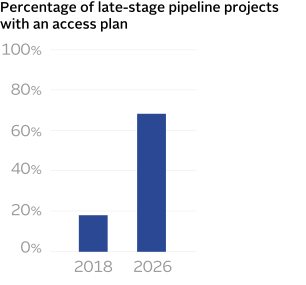
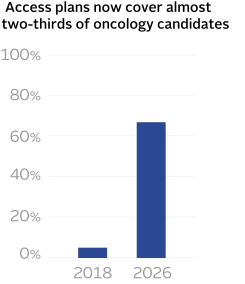
More companies are planning how their products will reach patients before they are approved, with the share of late-stage pipeline candidates covered by an access plan more than tripling since 2018, to 69% in 2026.
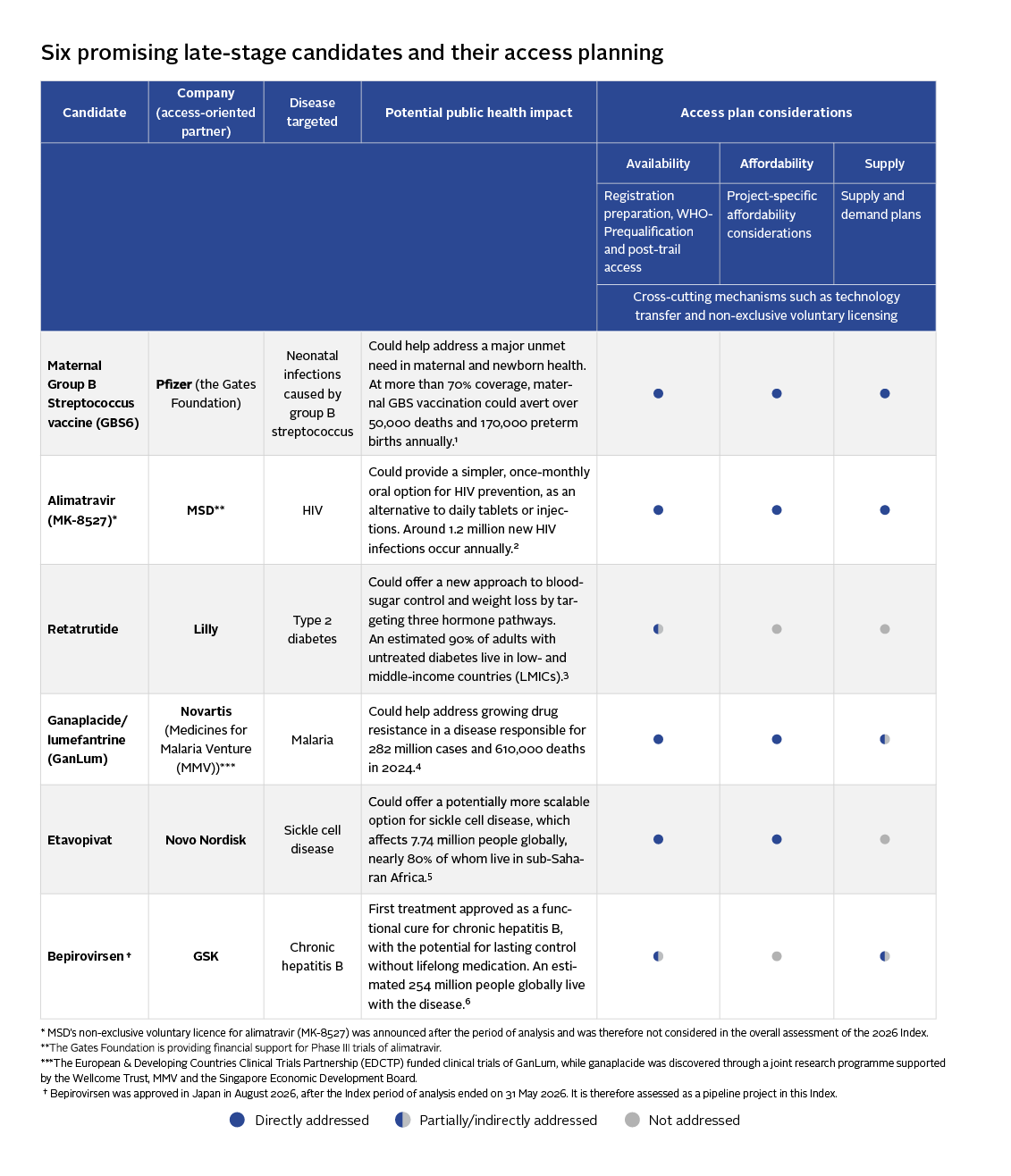
Six illustrative late-stage candidates across a range of diseases highlight the potential impact of the pipeline in low- and middle-income countries (LMICs). All have access plans in place, but these vary in how fully they cover availability, affordability and supply.
Among non-communicable disease (NCD) projects with an access plan, 43% focus solely on registration, primarily in upper-middle-income countries (UMICs), rarely extending to low-income and lower-middle-income countries.
Planning for access in LMICs while a product is still in development can help bring lifesaving innovations to patients in high-burden countries sooner. Companies can help address the barriers patients may face in accessing a product by planning for its availability, affordability and reliable supply well in advance, and by prioritising countries with the greatest need when deciding where those access plans will apply. Although companies are increasingly planning for access while their products are still in development, these plans vary in how comprehensively they address these barriers and how widely they extend across countries.
Promising new products could improve the lives of millions if they reach those who need them
Six products were selected as illustrative examples of advanced pipeline products with particular potential to address substantial unmet health needs in LMICs,* spanning a range of diseases and access-planning approaches. These were selected based on the burden of the diseases they target, gaps in existing treatment options and their potential to improve care – if successfully developed and made accessible, they could have a significant impact on health in LMICs. All six have access plans in place, but these plans vary in whether they include measures to support the availability, affordability and reliable supply of these products.
*The term LMICs refers to all low- and middle-income countries in scope of the Index. Where referring specifically to the World Bank income group, “lower-middle-income countries” is written out in full. The terms LICs and UMICs refer to low-income countries and upper-middle-income countries, respectively, in line with the World Bank income group classification. This convention does not apply to the Report Cards.
Across these products, plans most often address availability, while affordability and reliable supply receive less attention. But without plans that address the different barriers to access, even potentially high-impact products may not reach the people who need them. For example, registering a product does not necessarily mean it is available to patients. Even when it is marketed, patients may not be able to afford it. Conversely, affordability alone cannot ensure access without reliable supply. Some access mechanisms are cross-cutting: for example, voluntary licensing can support availability, affordability and reliable supply by enabling generic manufacturers to produce a product and increasing competition to reduce the price.
Notably, products developed with an access-oriented partner tend to have plans that cover more of these areas, pointing to the role these partnerships can play in strengthening access planning. Candidates targeting communicable diseases also tend to have plans that cover more aspects of access than those targeting NCDs. Looking beyond these late-stage products, similar patterns can be observed across companies’ broader pipelines, particularly in how access planning differs between disease areas, as explored in the next section.
Access plans for NCDs remain more limited than for communicable diseases
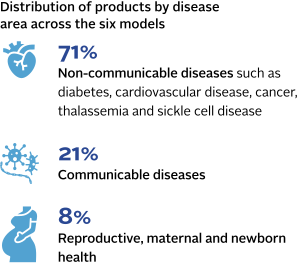
An estimated 73% of NCD deaths occur in LMICs, with the burden expected to rise, indicating that a large share of future patients and market growth will be concentrated in LMICs.7 This underscores the importance of access planning and presents a significant opportunity for companies from both a public health perspective and a commercial standpoint. The potential benefits of early access planning are twofold: addressing unmet health needs while building sustainable access and market presence over time. Effective plans should anticipate the main barriers to access.
However, across all NCD projects with an access plan, 43% have plans that focus solely on registration, supporting availability but not addressing other factors such as affordability and reliable supply. Several factors make access planning for NCDs particularly complex. Some NCD pipeline candidates require specialist care, diagnostics and stronger health-system infrastructure, while NCDs receive comparatively little global health funding. By contrast, products for diseases such as HIV, tuberculosis and malaria often benefit from established access-oriented partnerships, donor funding and pooled procurement mechanisms that support affordability, supply and delivery. Comparable financing and procurement mechanisms remain less established for many NCDs, and declining donor funding in global health reinforces the need for sustainable and scalable solutions that are less dependent on donor funding.
However, these challenges do not lessen the unmet need. Rather, they reinforce the importance of planning for access early, so that potential barriers can be anticipated and addressed as products advance through development.
The path to access differs across NCDs
Looking across the broader pipeline, three NCD disease areas – sickle cell disease, diabetes and mental health – have been selected for closer analysis. These disease areas have substantial unmet need in LMICs, are receiving increasing attention from policymakers and funders, and have multiple late-stage products with sufficient variation in access planning to assess how consistently companies are planning for access across their pipelines. They therefore provide useful examples for examining how access planning has the potential to translate innovation into meaningful patient access.
Sickle cell disease: Access planning is comparatively advanced, covering 5/6 (83%) of late-stage projects across five companies. Plans typically address multiple components, including registration, equitable pricing, and supply and demand planning, and cover an average of five countries, including lower-middle-income countries. The priority is therefore to ensure sufficient financing to implement and sustain these more comprehensive access plans, particularly in countries with the greatest burden.
Diabetes: Access plans cover 10/19 (53%) of projects across five companies and are generally narrower, focusing predominantly on registration in commercially attractive emerging markets.* With much of the pipeline concentrated on type 2 diabetes and GLP-1 medicines, and the burden of diabetes growing rapidly in middle-income countries amid changing lifestyles, population growth and economic development, there is a clear commercial opportunity for companies to expand access in these markets. However, the access challenge will be to ensure that access planning includes measures to reach underserved populations, not just those covered by health insurance or high-income groups.
*Emerging markets are actively developing economies characterised by rising incomes, expanding healthcare systems and growing populations, which are driving increased demand for medicines. These include Brazil, China, Colombia, Egypt, India, Indonesia, Mexico, South Africa, Thailand and Vietnam.
Mental health**: Access planning is least developed, covering 5/13 (38% ) of late-stage projects across three companies. Existing plans focus mainly on registration and include on average one emerging market. Future access plans will need to move beyond registration to address affordability for lower-income groups and consider partnerships that can support appropriate uptake and use.
** Includes anxiety disorders, bipolar affective disorder, depressive disorders and schizophrenia.
Together, these findings show differences in the maturity of access planning across NCDs. Sickle cell disease has comparatively broader and more developed plans, whereas diabetes and particularly mental health have more limited planning. These gaps are especially relevant in the context of growing policy and funder attention to NCDs. Across all three disease areas, recent global and regional initiatives have increased attention to treatment access, affordability and service delivery. This momentum creates an opportunity to strengthen access planning and build the financing, partnerships and delivery mechanisms needed to ensure innovative treatments reach patients in LMICs.
Paving the way to access through comprehensive planning
As innovations advance through the pipeline, strengthening access plans – both by addressing the different barriers to access and taking disease-specific challenges into account – can help create clearer pathways for products to reach patients in LMICs. Companies can:
Engage partners early in product development, including governments, local researchers and healthcare practitioners in LMICs, to inform product design around local needs and support country-led planning for introduction and uptake. Additionally, companies can work with local regulatory authorities to anticipate regulatory and evidence requirements and leverage existing pathways to facilitate timely registration.
Co-create access plans with partners in LMICs to reflect local needs and barriers rather than applying a uniform approach across the pipeline. This includes moving beyond registration-focused plans to incorporate specific measures addressing affordability, supply and other barriers in LMICs. For example, companies can support credible, locally led treatment programmes with reduced prices and reliable supply to ensure plans translate into meaningful patient reach following approval.
Ensure systematic access planning across the entire pipeline, for candidates targeting both communicable and non-communicable diseases, with particular attention to therapeutic areas with high disease burdens in LMICs.