Key findings
Promising pockets of progress emerge in cancer access, but the overall picture remains uneven
10 November 2026
10 November 2026
Across ten editions, the Access to Medicine Index has assessed how the world’s leading pharmaceutical companies are working to improve access to essential health products in low- and middle-income countries (LMICs). Over time, it has documented a clear shift in how companies approach access. From largely isolated philanthropic programmes, companies have moved towards more strategic, integrated efforts that increasingly embed access across business operations, while also adopting a broader range of mechanisms to improve the availability and affordability of health products. Together, these changes reflect a more systematic and sustained approach to access.
The Index itself has also evolved. Its assessments have moved beyond measuring commitments and processes to place greater emphasis on implementation and measurable outcomes, including whether company strategies are reaching the patients they are intended to serve. By benchmarking companies against their peers, identifying leading practices and highlighting gaps, the Index has served as a catalyst for change and has helped raise expectations for the pharmaceutical industry.
Progress, however, has been uneven. Although companies have made notable advances in embedding access considerations into their strategies, further action is still needed; access planning is not universally implemented across all pipeline candidates and persistent gaps in registration and affordability mean that life-saving products do not reach everyone that needs them.
Looking ahead, the challenge is converting this progress into broader, sustainable access for people in LMICs. By continuing to track implementation, patient reach and outcomes, the Index can help identify where action is delivering results, where gaps persist and what approaches are most capable of being scaled.
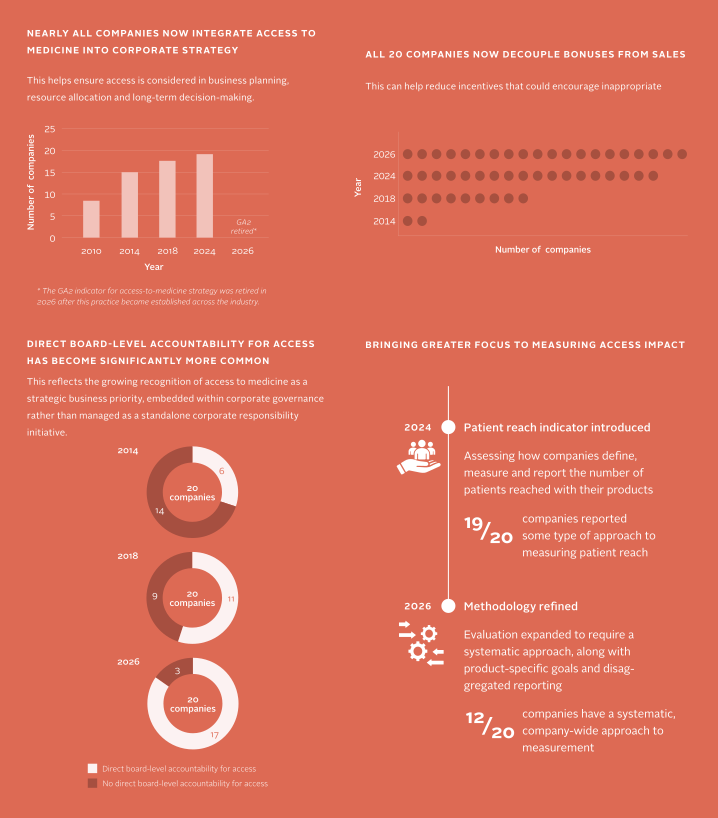
Since 2008, the Index has progressively raised expectations for how pharmaceutical companies govern and oversee their work on access to medicine. Over time, the focus has expanded from encouraging companies to articulate a clear access strategy to assessing whether they demonstrate robust board and executive accountability, align incentives with access objectives, and measure and report the number of patients they reach. The progress seen across the Governance of Access Technical Area closely mirrors this evolution, with many of the policies and practices that the Index has encouraged becoming standard across the industry.
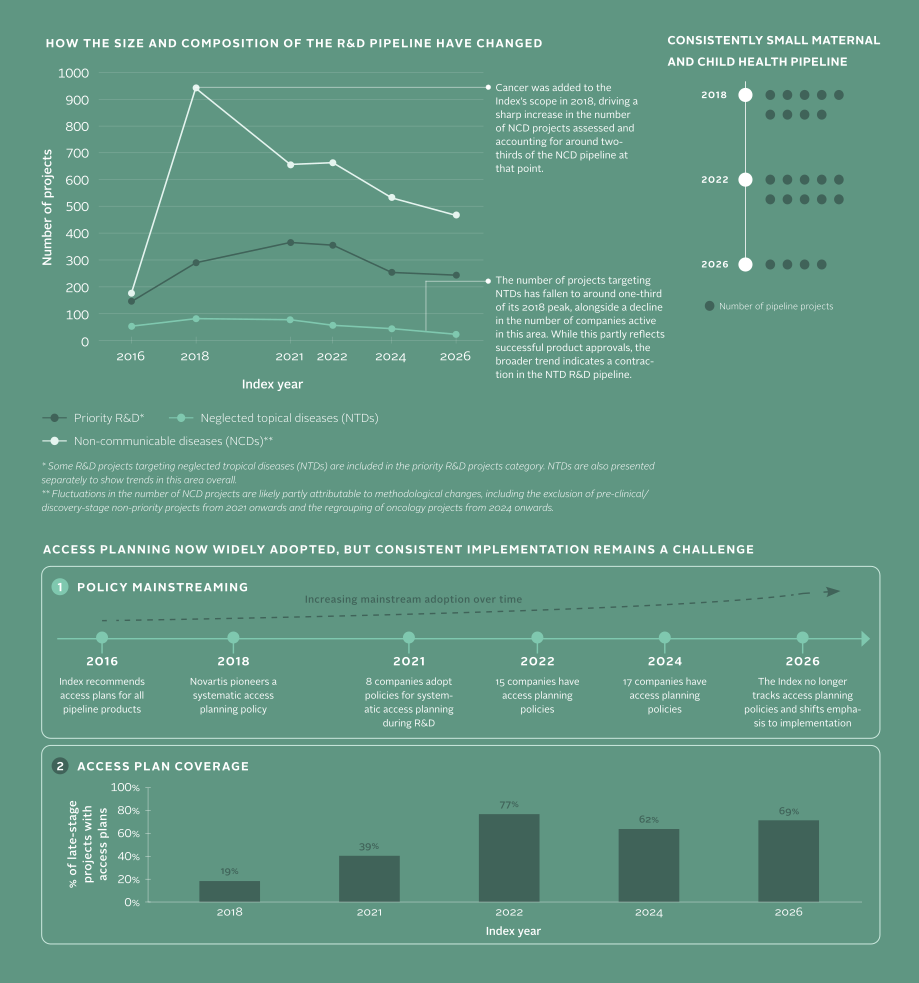
Over ten iterations of the Index, expectations of pharmaceutical research and development (R&D) have evolved. Companies have delivered important breakthroughs for diseases with high unmet need, including malaria, HIV, drug-resistant tuberculosis, Ebola and neglected tropical diseases. However, the size and composition of their R&D pipelines have fluctuated over time. While non-communicable diseases have consistently dominated these pipelines, areas such as maternal and child health have received less attention.
The focus has also increasingly extended beyond what companies develop to how those products will reach patients. Planning for access during R&D has become more common over the past decade. By 2026, most companies had policies in place to consider access during development, although this is still not consistently reflected in plans across their pipelines.
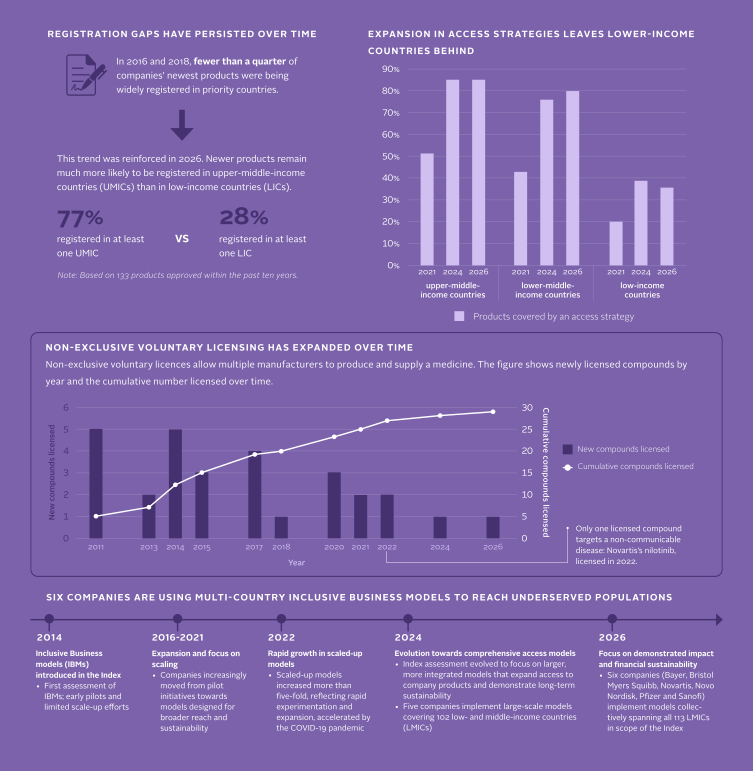
Over ten cycles, the Product Delivery analysis has evolved alongside changing expectations of what meaningful access looks like. Earlier editions examined a range of concrete measures shaping access, from access strategies and registration to licensing. As the Index has developed, the analysis has gone deeper, connecting these elements more explicitly to their implications for access in practice, including how these approaches translate into measurable patient reach. This evolution reflects a broader shift in company practice, with access strategies becoming more structured, diversified and sustainable, drawing on a growing range of approaches including differential pricing, second brands, patient support programmes, licensing, technology transfer and local partnerships. Yet the Index has also consistently revealed where access remains uneven. Registration continues to favour larger upper-middle-income markets, while lower-income countries are reached less often and later. Access-strategy coverage has improved, but important gaps remain, particularly in low-income countries.