Key findings
Thin pipeline, high stakes: How are companies planning to expand access to vital, new antimicrobials?
10 March 2026
10 March 2026
Across the 17 companies assessed, Aurobindo, GSK and Sandoz stand out for reporting compliance with antibiotic waste limits for both in-house and supplier production of all their antimicrobial products.
Companies reporting on supplier compliance has doubled since 2021 (4 to 8), with generic producers leading this improvement. However, nine companies do not disclose details of supplier compliance at all.
Currently, all waste limits are being measured and met in receiving waters, after dilution may have occurred. By doing this at ‘end-of-pipe' before waste is released into the environment, antimicrobial resistance and environmental risk can be contained even further.
The global production of antibiotics can release waste into rivers and soil around manufacturing sites. When this waste is not properly controlled, it creates the perfect breeding ground for drug-resistant bacteria, threatening the very antibiotics we rely on to save lives. Ensuring antibiotic waste from manufacturing is managed responsibly is one of the ways in which pharmaceutical companies can limit antimicrobial resistance (AMR), while also protecting people and the environment. The 2026 AMR Benchmark assessed seven large researchbased companies and ten generic medicine manufacturers on how they ensure compliance with antibiotic discharge limits – both in-house and at supplier sites. Overall, there has been improvement in meeting limits once waste has been released into the environment. However, in line with measures recommended by the World Health Organization (WHO), ensuring compliance before waste is released into the environment would further help protect ecosystems and communities worldwide. Currently, none of the companies assessed by the Benchmark report doing this.
Given that companies have full control over their own manufacturing sites, meeting waste limits at direct operations is a baseline of expectation. Of the 17 companies assessed, ten share details on whether their in-house antibiotic production meets discharge limits. Notably, seven of these companies – Aurobindo, Cipla, GSK, Sandoz, Shionogi, Sun Pharma and Viatris – indicate 100% compliance in the receiving environment where waste is released for all antibiotics produced in-house.
By controlling impacts across their supply chains, and not just within their own facilities, companies can prevent the creation of resistance hotspots linked to manufacturing. Encouragingly, the Benchmark finds that the number of companies reporting on supplier compliance has doubled from four to eight since 2021. Aurobindo, GSK, Hikma, Sandoz, Fresenius Kabi, Shionogi, Viatris and Teva share details on whether suppliers they contract for antibiotic production are compliant with waste targets in the receiving environment (see Figure 1). Aside from Teva, these companies all exceed the industry average of 40%1 of products manufactured by suppliers that comply with discharge limits.
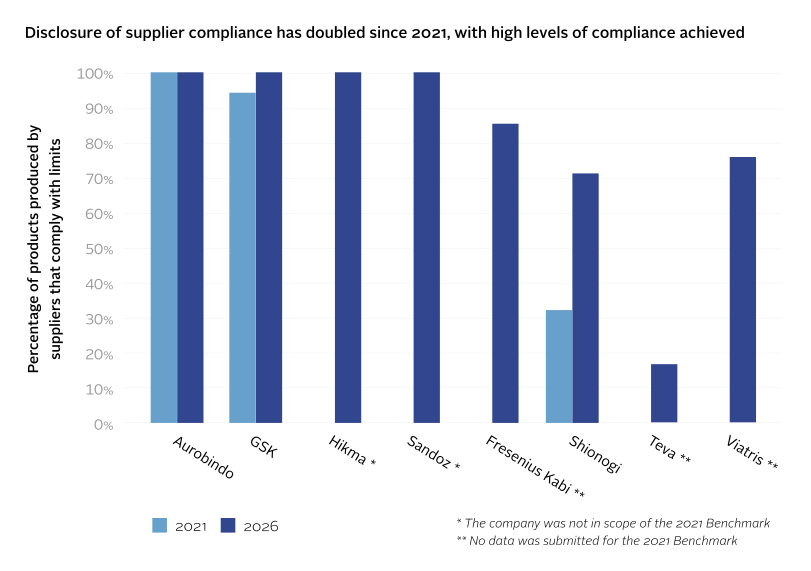
The improvement among generic companies is strongest, with six now reporting supplier compliance, compared to just one in 2021. This progress is a critical development, as the ten generic companies assessed account for nearly one-fifth of global antimicrobial sales, making their practices instrumental in minimising manufacturing-related AMR risks. Notably, generic producer Fresenius Kabi, which has not previously reported supplier compliance to the Benchmark, now reports that 86% of all products manufactured by its suppliers meet safe discharge limits in the receiving environment (i.e., rivers and waterways). As an important producer of sterile injectable antibiotics, which often require more water intensive manufacturing than other types of antibiotics, ensuring proper wastewater management is critical.
Aurobindo, GSK and Sandoz achieve 100% compliance in receiving waters for all products manufactured both in-house and at their supplier sites, demonstrating end-to-end control of environmental and AMR risks across their supply chains. Notably, both GSK and Sandoz achieve this across a vast network of external suppliers, demonstrating that achieving compliance at scale across supply chains is attainable.
Companies employ a range of approaches to ensure their suppliers meet waste targets. Most companies (11/17) conduct supplier audits to monitor whether discharge limits are being met – and also request suppliers to implement Corrective and Preventive Action plans (CAPA plans) when waste levels are too high. Seven companies – Abbott, Aurobindo, GSK, Sandoz, Pfizer, Teva and Shionogi – do this through contractual provisions that expect supplier compliance with discharge limits. Six companies also demonstrate actively engaging their suppliers in complying with these discharge limits. Abbott, Aurobindo, Cipla, GSK, Sandoz and Shionogi do this by, for example, guiding suppliers on quantifying discharge levels, how to adjust waste management processes and offering free wastewater analysis. By engaging and educating suppliers, these companies are actively helping them achieve compliance. Notably, Aurobindo, GSK and Sandoz report 100% supplier compliance, indicating that a more hands-on approach can help yield demonstrable results.
The growing global recognition that antibiotic waste drives resistance is leading to stricter expectations from stakeholders. As a result, governments and buyers, both in high-income countries but also in countries with large manufacturing hubs such as China and India, are tightening rules and introducing new mechanisms for regulators to better monitor antibiotic residues in wastewater.2 Despite the voluntary efforts – and improvements – from some companies, seven do not report on compliance at their direct operations, and nine do not share details on compliance by suppliers. At the moment, all companies that do report compliance only assess compliance in receiving waters, as per AMR Alliance Antibiotic Manufacturing Standard. No company currently measures discharge directly at end-of-pipe according to WHO ‘Stringent’ guidelines, which would better indicate how responsibly a site manages waste and limits AMR risk.
It is encouraging to see the steps companies are taking with their suppliers to ensure the responsible management of antibiotic waste across the supply chain, but it is vital that higher levels of compliance in the supply chain are achieved by more companies across the board. Not only will this have a significant impact on curbing AMR and protecting people, but it will set companies up for sustainable business amid rising expectations from stakeholders.
By being transparent on how compliance is assessed and what the actual discharge levels are, companies can offer muchneeded insights into the relationship between wastewater management and AMR while also meeting expectations from stakeholders.
Companies can work towards expanding and strengthening contractual obligations for their suppliers, while also supporting them by sharing knowledge, resources, expertise and analytical capabilities. Better external auditing and reporting of compliance across the industry, including manufacturers not currently assessed by the Benchmark, will also be important to ensure consistent compliance.
By adopting WHO’s ‘Stringent’ wastewater management guidance and supporting suppliers to do the same, companies can cut antibiotic pollution at the source, directly slowing the rise of AMR and driving lasting industry-wide change.
Stakeholders, such as regulators, procurers, investors and licence partners can further implement waste standards that ensure compliance across the supply chain. For example, legislators can set basic requirements on waste practices while procurers can reward companies that adhere to WHO’s stringent guidance.
1. AMR Industry Alliance. (2023). AMR Industry Alliance progress report 2023. https://www.amrindustryalliance.org/wp-content/uploads/2024/02/AMRIA_ RS-access-and-appropriate-use_FINAL_24Jan24.pdf
2. World Health Organization. (n.d.). China national action plan on AMR (2022–2025). https://cdn.who.int/ media/docs/default-source/antimicrobial-resistance/ amr-spc-npm/nap-library/china-national-action-planon-amr-(2022-2025)---eng.pdf?sfvrsn=e3bf8980_4
