Key findings
Thin pipeline, high stakes: How are companies planning to expand access to vital, new antimicrobials?
10 March 2026
10 March 2026
For the first time, the AMR Benchmark assessed the approaches used by generic medicine manufacturers to track and monitor patient reach – with six of the ten companies doing this across almost all their antibiotic and antifungal products analysed.
Sales volume remains the main measure for estimating patient reach, but four companies – Abbott, Hikma, Sandoz and Viatris – integrate additional data points for different antimicrobial products in their portfolios to more accurately track how many patients are being reached by these products in low- and middle-income countries.
Notably, Sandoz and Viatris are the only companies assessed by the Benchmark that do this across all of their medicines assessed.
Generic medicine manufacturers produce the vast majority of the world's antibiotics and antifungals, and their role is especially critical in low- and middle-income countries (LMICs). With many innovator companies exiting or scaling back their antimicrobial research and development (R&D) and portfolios in recent years, the world has become increasingly reliant on existing, off-patent generic antibiotics to treat both common and serious infections. Because of their scale, local presence and participation in national or hospital tenders to supply at lower prices, these manufacturers are uniquely positioned to enable access to these lifesaving medicines to large patient populations, while also helping preserve their effectiveness.
To do so, however, companies need a granular picture of where their lifesaving treatments are used, how they are used and how many patients they truly reach. This is especially important for antibiotic and antifungal (antimicrobial) products. Unlike other medicines, higher sales volumes do not necessarily indicate improved patient outcomes, as drug resistance is fuelled by overuse and misuse. Conversely, limited access results in untreated infections, suboptimal therapies and increased numbers of deaths. By systematically tracking patient reach across their portfolios – and integrating these insights into their access and stewardship strategies – companies can pinpoint gaps in access and identify areas of potential overuse that heighten the risk of antimicrobial resistance (AMR). Patient reach data can also help target registration, supply and stewardship efforts where they are most urgently needed.
The 2021 AMR Benchmark already reported on the total numbers of patients being reached with antimicrobials, but the ways in which companies determined these numbers (i.e., their patient reach methodologies) were not assessed. This iteration of the Benchmark – which analysed seven large research-based pharmaceutical companies and ten generic medicine manufacturers – provides the first assessment of the methodologies companies use to calculate patient reach for the antimicrobials in their portfolios.
Among the companies assessed, six generic medicine manufacturers – Abbott, Aurobindo, Cipla Hikma, Sandoz and Viatris – stand out for providing details on how they calculate patient reach in LMICs across almost all of their antibiotic and antifungal products analysed (see figure below).
Tenders are commonly used by procurers, particularly in LMICs, to purchase large volumes of off-patent medicines at lower prices. Therefore, it is not surprising for companies to estimate patient reach using sales and purchasing data.
However, the Benchmark finds that Abbott, Hikma, Sandoz and Viatris all consider additional factors beyond global sales data in their patient reach approaches to better estimate the number of patients receiving their antimicrobial medicines in specific countries. Although Aurobindo and Cipla only use sales volumes to track patient reach, both companies do this on an individual product and country level.
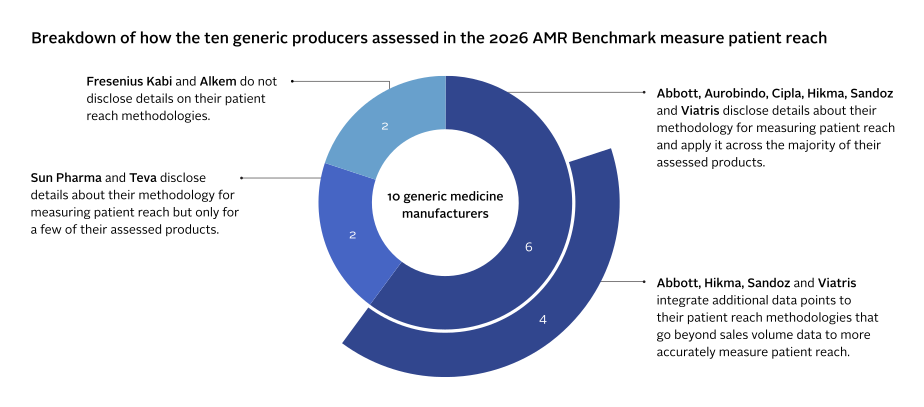
Not only do Sandoz and Viatris go beyond sales volume to estimate their patient reach, but they are also the only two companies assessed by the Benchmark that effectively measure patient reach across all their assessed medicines. Sandoz does this by adjusting its sales data based on the defined daily doses and treatment duration of each medicine, which can help provide a clearer picture of how many patients have actually received these medicines.
This is important because, even in high-income countries, incomplete treatment and inappropriate antibiotic use remain major drivers of resistance. Although the data was provided under a non-disclosure agreement (NDA), Sandoz was able to share disaggregated, country-level patient reach estimates for all nine medicines.
Viatris uses sales volume data and estimated per-patient usage, which is based on treatment dose, duration and adherence. While also provided under an NDA, Viatris does share disaggregated patient reach data at the country level* for its products as well.
By calculating patient reach data at the country level, pharmaceutical companies gain a better understanding of usage patterns. This enables them to tailor their product portfolios, including formulations and dosages they offer, to specific regions and patient populations, ensuring therapies are more effective and better aligned with patient needs.
Abbott and Hikma have strong patient reach approaches that could be applied more widely to their other products
Abbott and Hikma also consider additional factors beyond sales data in their patient reach approaches. However, neither company has yet applied these methodologies across its entire antimicrobial portfolio to systematically calculate product-level patient reach estimates.
Unlike most companies that rely on internal sales data, Abbott uses real-world sales data sourced from IQVIA. This data is compared to a country’s population to get an indication of patient reach and then adjusted for three additional factors: treatment duration, patient adherence and disease prevalence. While Abbott’s patient reach methodology is strong, patient reach estimates are currently available only at the portfolio level, not for individual products. Hence, for the nine off-patent/generic products assessed, Abbott did not report patient reach estimates employing this approach. However, the company provided disaggregated, country-level sales volume for most products (6 out of 9).
While Hikma only provided patient reach estimates for 5 of 11 products assessed, the company’s approach aims to better reflect the actual number of patients receiving treatment, specifically by accounting for treatment duration. For example, Hikma estimates that with one of the antifungal medicines in its portfolio – fluconazole – it has reached 360,000 patients in India. For the remaining six products assessed, Hikma provided disaggregated, country-level sales volume instead.
It is encouraging that Abbott and Hikma are tracking patient reach beyond sales data for some products, but applying this across all of their antibiotics and antifungals will be key to identifying access gaps and promoting appropriate use.
Although Aurobindo and Cipla only use sales volumes to track patient reach, both companies do this on an individual product and country level, providing a more accurate baseline for patient reach estimates than global sales volume reporting does.
Aurobindo consistently tracks sales volumes at both the individual product and country levels and transparently reports this data to the Benchmark for all eight off-patent/generic medicines from its portfolio selected for analysis. For example, Aurobindo reports selling approximately 15 million doses of amoxicillin to Vietnam and one million doses of amoxicillin-clavulanic acid to Nepal, respectively. Similarly, Cipla consistently tracks and transparently reports sales volumes at both the individual product and country levels for all 12 medicines in its portfolio selected for analysis, two of which are on-patent antibiotics. For the on-patent antibacterial medicine cefepime-enmetazobactam (CIPENMET and Esblocip), Cipla reports selling a total of 162,338 units directly to hospitals in India.
It is critical for companies to apply patient reach methodologies that go beyond sales volume reporting across their entire portfolios. In addition, companies should implement these methodologies and track patient reach at the individual country and product level. This is especially important in supporting more responsible access and stewardship of antimicrobials everywhere by ensuring these lifesaving medicines are used where they are truly needed, in the right quantities – safeguarding patients and reducing the global spread of drug resistance.
It is vital that:
Companies use more accurate patient reach and usage estimates internally to inform their access strategies and drive more targeted applications for tenders in LMICs so that their lifesaving treatments can be brought to people living in countries with the highest burden of disease.
With antimicrobial products, the goal should not just be to reach as many people as possible. The number of patients reached should match the actual medical need in specific countries. Because different antibiotics are used for different purposes, internal company incentives should focus on proper treatment and good health outcomes, not on selling or prescribing more antibiotics than necessary.
*Viatris provided the number of patients reached at the country level for all products assessed except one, tobramycin, for which only the global number of patients reached was provided, as it had only recently been launched in a country in scope of the Benchmark.
