Key findings
Thin pipeline, high stakes: How are companies planning to expand access to vital, new antimicrobials?
10 March 2026
10 March 2026
Access gaps in paediatric antimicrobials persist, evidenced by a sparse research and development pipeline and limited availability of medicines already on the market.
Only 13% of antimicrobial pipeline projects belonging to companies assessed by the AMR Benchmark are developed for children under five, leaving delays in paediatric approvals, even for existing antibiotics.
Among these companies with paediatric formulations on the market, five – Aurobindo, GSK, Hikma, Sandoz and Teva – stand out by registering their paediatric formulations, on average, in more than 50% of the low- and middle-income countries where they register their other off-patent antimicrobials. Despite this, gaps in access are prominent in 17 sub-Saharan African countries, where no child-friendly versions of any of these products have been registered by any of the companies assessed by the Benchmark.
Right now, there simply are not enough child-friendly formulations to treat bacterial infections. Even among World Health Organization (WHO)-recommended Access, Watch, and Reserve antibiotics, many lack age-appropriate formulations or doses.1 Overall, of all new antibiotics introduced since 2000, only 10% carry a paediatric label.2 This gap is particularly pronounced for antibiotics used to treat drug-resistant infections – such as neonatal sepsis caused by hard-to-treat gram-negative bacteria.3 Developing safe and appropriate dosage forms for children – especially neonates, who require very small doses – remains a challenge. In cases where childfriendly antimicrobials exist, gaps in access mean that they are not always readily available to those who need them in low- and middle-income countries (LMICs).
A two-fold approach is required to close gaps in both innovation and access: advancing neonatal and paediatric label extensions and dosage forms for existing antimicrobials and ensuring equitable access to those already available.
With antimicrobial resistance (AMR) rising, the efficacy of existing products is at risk. Yet, across the pipelines of the seven large research-based companies and eight small and medium-sized enterprises assessed, only five of the 39 projects targeting WHO-listed priority pathogens in clinical development are specifically designed to meet the needs of children under five.

Notably, two of these projects – Pfizer’s antibiotic aztreonam- avibactam and Shionogi’s cefiderocol – which both target serious, life-threatening multidrug-resistant gram-negative bacterial infections, are on WHO’s Paediatric Drug Optimisation for Antibiotics (WHO PADO) list. This list highlights antibiotics for which the development of age-appropriate paediatric versions is much needed.1 However, as seen in the above figure, paediatric approvals – specifically for children under five – can take years.
These delays are, in part, attributable to the complexities of developing and marketing age-appropriate medicines, such as strict ethical and regulatory requirements. However, it is also crucial for companies and other stakeholders to ensure that paediatric developments – especially adaptations of existing, successful adult formulations – reach children with as little delay as possible. For example, Johnson & Johnson’s anti-tuberculosis (TB) medicine, bedaquiline, is still being evaluated in children under five years of age (see figure below).
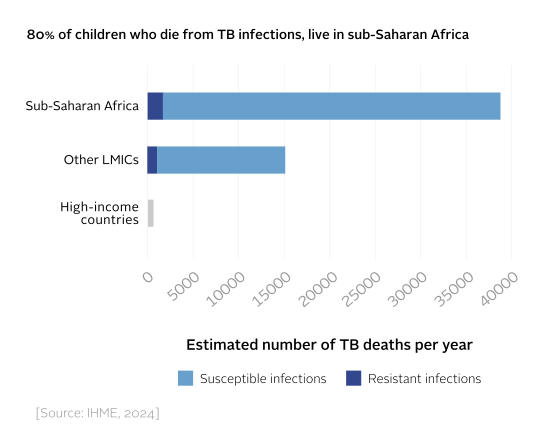
Although the drug was approved for adult use in 2012, the paediatric formulation for children over five was not approved until 2020, highlighting that, for almost ten years, children lacked access to an age-appropriate formulation of this critical treatment. For children living in sub-Saharan Africa, where the burden of TB is highest (as per the figure above), access to treatments that can overcome drug-resistant TB is vital.
Early parallel development of adult and paediatric formulations, combined with proactive access planning, can help bridge delays and support timely availability. For its PADO-listed aztreonam-avibactam, for example, Pfizer is planning for access for young children, with Phase II trials initiated prior to product approval in 2024. Rising resistance against carbapenems, one of the few effective classes for treating drug-resistant infections in children, now already leaves about 19% of children without effective treatment options, putting them at high risk of death.2 With its ability to treat carbapenem-resistant gram-negative infections, Pfizer’s aztreonam-avibactam has the potential to offer a treatment option for children who are currently left without, including difficult cases of neonatal sepsis. Ensuring plans are in place to make aztreonam-avibactam available to children and neonates as quickly as possible can fill this gap and save lives.
Once a product is approved and exits the pipeline, registration is the first step a company can take to ensure availability. Although registration does not guarantee a product’s availability, it signals a company’s intent to make it commercially available and serves as a critical first step to initiating access. The Benchmark assessed 19 marketed antimicrobial medicines (18 antibiotics and 1 antifungal) across the portfolios of six large research-based pharmaceutical companies and eight generic medicine manufacturers,* all of which are included on WHO’s Model List of Essential Medicines for children (EMLc) – which means they should be available and affordable everywhere.
Overall, the 14 companies register paediatric formulations of antimicrobials in a combined total of 79 of the 113 countries covered by the Benchmark. Access antibiotics, such as amoxicillin and amoxicillin-clavulanic acid – both essential first-line treatments commonly used for the treatment of respiratory and urinary tract infections – are registered most widely (also see Industry Trends chapter).
Of the 14 companies assessed, five – Aurobindo, GSK, Hikma, Sandoz and Teva – stand out by registering their paediatric formulations, on average, in more than 50% of the LMICs where they register their other off-patent antimicrobials. Generic producer Sandoz performs best in registering such child-friendly dosage forms, with paediatric versions of its antimicrobials registered in about 85% of the LMICs where it registers its off-patent antimicrobials
Sandoz also stands out for registering its paediatric formulations across 14 of the 46 sub-Saharan African countries covered by the Benchmark. However, registrations of the 19 products across companies’ portfolios are otherwise limited in this region, where the burden of infectious diseases – and its impact on children – is disproportionately high. In 17 countries, none of the companies assessed by the Benchmark register existing paediatric formulations of any of their antimicrobials (see figure below). Some of these countries lack National or Regional Regulatory Authorities, making registration unfeasible. However, in ten of these countries, companies already register adult formulations of their products, indicating that there is scope to do this for paediatric formulations in these ten countries as well.

South Africa and Namibia are the only sub-Saharan African countries where more than ten different types of paediatric formulations of antibiotics produced by the 14 companies are registered, with coverage in other countries being very patchy. For example, in only 11 countries are more than five products registered. When only a few antibiotics are registered, it limits treatment options, fuels resistance and leaves children vulnerable to otherwise treatable infections.
Given that the few paediatric antimicrobial products that are available are not registered as widely as needed, companies need to continue driving efforts to expand access to the drugs we already have. But, at the same time, new treatments are also urgently needed.
*Abbott, Fresenius Kabi and Shionogi were not assessed here, as specific paediatric formulations for the products selected for analysis could not be confirmed within their portfolios.
By initiating paediatric studies in parallel with adult development early on – once Phase I is completed or during early Phase II trials – companies can proactively conduct clinical trials to test the safety and efficacy of their products in children to avoid delays as much as possible. Prioritising paediatric formulations and dosing strategies early on, especially for diseases with high mortality rates in children under five, can also accelerate drug development.
Companies can align their development efforts with WHO’s Global Accelerator for Peadiatric Formulations Network (GAP-f) to ensure resources are channelled into the most urgent and impactful treatments as per GAP-f's PADO list.
In parallel, companies should develop access plans from Phase II onwards to ensure that new pipeline projects become available without delay for paediatric populations in LMICs.
To accelerate access to children, especially in LMICs, companies can ensure paediatric formulations of marketed antibiotics are registered widely in the countries where they are needed, and in the same countries as their corresponding adult products.
Beyond registration, companies can utilise further access strategies to ensure that registered products actually reach the children who need them.
World Health Organization. (2025, March 24). Paediatric drug optimization for antibiotics – Meeting report. https://iris.who.int/server/api/core/bitstreams/690f07e9-fa87-4cc6-9f8c-a4734058866f/ content
Barnhart, M., & Barber, R. G. (2023, November 7). Antibiotics that fight deadly infections in babies are losing their power. NPR. https://www.npr.org/ sections/goatsandsoda/2023/11/07/1209109088/ antibiotics-that-fight-deadly-infections-in-babies-arelosing-their-power
Global Antibiotic Research & Development Partnership. (2024). Survive and thrive: Improving the global AMR response for healthier children and newborns — Paediatric policy paper (Nov 2024). https://gardp.org/wp-content/uploads/2024/11/ GARDP_Paediatric-Policy-Paper_202411.pdf
Institute for Health Metrics and Evaluation. (2024, September 16). MICROBE.

Director of Research
cmartinez@accesstomedicinefoundation.org
31626288253
Get in touch