Research
Pfizer demonstrates comprehensive access planning for a maternal health vaccine in the pipeline
10 November 2026
10 November 2026
Sanofi
Publicly reports country-level information for its Global Health Unit on patient reach, activities, initiatives and partnerships.
Enable stakeholders to assess progress against its access commitments and understand how its inclusive business model is implemented across countries.
42 low- and middle-income countries
Public commitments to expand access are difficult to assess or learn from when companies provide limited transparency on the activities and outcomes underpinning them. Publishing disaggregated data on these activities and outcomes enables stakeholders to understand how access efforts are being implemented, assess progress against commitments and identify lessons that can inform future efforts.
This is particularly important for inclusive business models (IBMs), which often combine patient reach goals with long-term approaches to addressing multiple barriers to access. Reaching more patients with affordable products is central to the purpose of these models, making patient reach figures a key indicator of whether they are delivering on their commitments. To assess whether these models are effective or likely to achieve their intended impact, it is also necessary to understand the activities supporting these outcomes and how implementation varies across countries.
To assess whether inclusive business models are effective or likely to achieve their intended impact, it is necessary to understand the activities supporting these outcomes and how implementation varies across countries.
Across the five other companies with IBMs – Bayer, Bristol Myers Squibb, Novartis, Novo Nordisk and Pfizer – public reporting on country-level implementation is limited. While some have shared more granular information directly with the Index, including under non-disclosure agreements, this information is not publicly accessible. Against this backdrop, Sanofi stands out for the breadth of country-level information it makes publicly available through its Global Health Unit (GHU), including patient-reach data, health system strengthening activities and partnership details. It is important to note that this transparency provides valuable insight into the implementation and reported reach of the GHU, but does not in itself indicate that the GHU achieves stronger access outcomes than comparable initiatives at other companies. The GHU offers 33 products* and operates in 42 low- and middle-income countries (LMICs), 35 of which are low-income countries, least developed countries or both. It has committed to reaching two million people with products for non-communicable diseases (NCDs) by 2030.1
Country-level patient-reach figures – that is, the number of people reached by companies’ products in each country – provide a clearer picture of where and at what scale people are being reached than aggregate totals alone. Making this data publicly available strengthens accountability by enabling comparison across settings and showing where gaps remain.
Sanofi applies this practice through a publicly available interactive map that reports patient-reach figures separately for individual countries in which the GHU operates, rather than only as a single total across all countries.1 These figures are updated quarterly. By linking its public commitment to regularly updated country-level patient-reach data, Sanofi enables stakeholders such as governments and implementing partners to track changes in reported reach over time, inform future access efforts and identify opportunities for improvement.
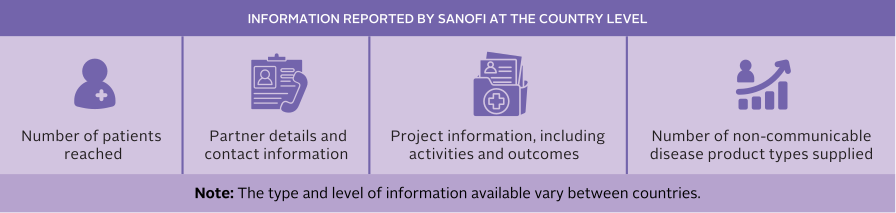
While patient reach figures remain the principal outcome reported for the GHU, the additional country-level information Sanofi publishes helps explain how the IBM is implemented and how access is supported in different settings. Depending on the country, this may include details on projects and other health system strengthening and capacity-building activities, such as the number of NCD projects, the number of NCD product types supplied and the number of healthcare professionals and community health workers trained.
This broader reporting places patient-reach figures in context by showing the training, projects and health system support associated with delivery in each setting. Making this information publicly available at country level provides accessible evidence of implementation, helping stakeholders understand how approaches differ across countries and identify lessons that may inform future access efforts.
Access initiatives in LMICs often depend on collaboration among a range of partners. Government partners may include local ministries of health and national health programmes, while other partners may include international distributors, local or regional non-governmental organisations, faith-based organisations and local entrepreneurs. Through the GHU, Sanofi publicly identifies partners by country and project, alongside details such as project objectives, duration, reported outcomes and links to partner websites where available.
This transparency can help companies, donors, governments and implementing organisations identify local and international partners with relevant experience in particular settings. It also gives greater visibility to the organisations delivering activities on the ground and can support learning and coordination across access initiatives, reflecting the collaborative nature of expanding access in LMICs.
Sanofi stands out for making a broad range of country-specific information on GHU implementation and reported progress towards its commitment publicly available. This helps external stakeholders follow changes over time, understand how the model operates in different settings and see how delivery varies between countries. It can also support learning, coordination and more informed decision-making, helping to strengthen future efforts to expand access to medicines.
Companies making long-term access commitments, particularly through IBMs, can strengthen accountability by publishing more granular information at country level. Reporting patient reach figures by country shows where patients are being served and how reported progress is distributed. Sharing additional information on implementation activities and partnerships further explains how delivery is supported, which organisations are involved and which approaches may be relevant in other settings. Companies can also work more closely with implementing partners to collect country-level data on both patient reach and health outcomes, enabling them to assess not only how many patients are reached, but also whether patients are benefitting from the treatments they receive.
*29 of 33 products address diseases in scope.
