Research
Pfizer demonstrates comprehensive access planning for a maternal health vaccine in the pipeline
10 November 2026
10 November 2026
Roche
Conducts several oncology clinical trials in sub-Saharan Africa.
Increase the inclusion of underrepresented cancer populations in clinical research.
Sub-Saharan Africa
Conducting clinical trials in underrepresented populations helps generate evidence that is more representative of the people who will ultimately use new medicines, while also providing earlier access to innovative treatments and strengthening local clinical research capacity. In many cases, clinical trial locations also determine where companies prioritise access once products are approved.
In Africa, clinical trial activity remains disproportionately low, accounting for less than 3% of all clinical trials conducted globally.1 This gap is particularly pronounced in oncology, where trials often involve innovative, complex and costly therapies. Conducting oncology trials requires specialised diagnostics, infrastructure and trained personnel, which are not consistently available across all settings.
However, within the period of the analysis, Roche has conducted multiple oncology trials across a broader range of sub-Saharan African countries than its peers, where oncology research remains limited. Through these trials, the company is generating evidence relevant to local populations, supporting future clinical research, providing earlier access to innovative treatments and helping to lay the groundwork for access should these products be approved and launched.
Roche distinguishes itself among companies in scope by conducting oncology clinical trials across six countries in sub-Saharan Africa (see map). While other companies also conduct clinical trials in the region, these are predominantly focused on neglected tropical and infectious diseases. Where trials address non-communicable diseases, they are typically concentrated in South Africa, where clinical research infrastructure and capacity are more established.
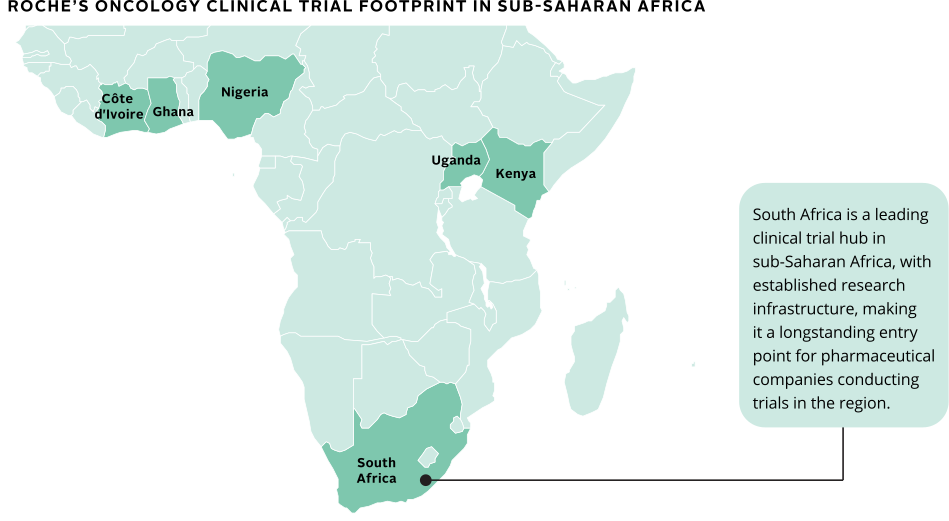
Several of Roche’s clinical trials focus on breast cancer, helping to address not only the underrepresentation of African patients in cancer research, but also the particularly limited inclusion of African women.
Roche’s approach broadens the inclusion of underrepresented cancer populations in clinical trials. Notably, several of the trials focus on breast cancer – the most commonly diagnosed cancer and the leading cause of cancer-related mortality among women in Africa2 – helping to address not only the underrepresentation of African patients in cancer research, but also the particularly limited inclusion of African women. These include three ongoing Phase III trials of giredestrant – an investigational treatment for for oestrogen receptor-positive breast cancer (ER+) – across Kenya and Uganda, as well as a landmark clinical trial of inavolisib (Itovebi®), initially approved in 2024, which is also being conducted in both countries.
Within the period of analysis, Roche also conducted the largest multi-country Phase III oncology trial undertaken in sub-Saharan Africa in the past decade, enrolling patients from six sub-Saharan African countries: Côte d’Ivoire, Ghana, Kenya, Nigeria, South Africa and Uganda.3
Roche's clinical research efforts also extend to earlier stages of development. The company stands out for conducting a Phase I clinical trial of divarasib (GDC-6036) – an investigational treatment for KRAS G12C-mutated advanced or metastatic solid tumours – in Kenya. This is notable because the limited clinical trial activity for non-communicable diseases in Africa has historically been concentrated in later stages of clinical development.
Industry participation in oncology clinical research in sub-Saharan Africa remains limited. However, Roche demonstrates that clinical trials for innovative oncology therapies – often perceived as too complex to conduct in resource-constrained settings – can be successfully conducted in the region. The company's oncology trials in the region span Phase I through to later-stage clinical development, illustrating that these settings are capable of supporting complex clinical research. Underpinning this approach is sustained investment in research capacity and partnerships with local clinical centres, which can strengthen research infrastructure and facilitate future clinical research.
Given that oncology accounts for approximately half of the clinical candidates in the 2026 Index's overall pipeline, companies can use this example as a basis for including lower-income countries in their clinical trial networks. Following Roche's example can facilitate future access to medicines in these settings while promoting greater equity in innovation. It also enables companies to generate evidence across more diverse patient populations, making clinical data more applicable to real-world use and providing earlier access to investigational therapies for trial participants. In the longer term, conducting clinical trials in these settings can also strengthen the pathway to faster access to newly approved products in the countries where trials have taken place.
