Research
Takeda facilitates broader access to its dengue vaccine through varying mechanisms
10 November 2026
10 November 2026
Novartis
Systematically measure patient reach across portfolio, transparently disclose patient reach approach and its components, set and share well-defined patient reach targets and publicly report patient reach data with increasing levels of disaggregation.
Facilitate more accurate patient reach measurement, identify gaps in access, effectively track the progress of access efforts and better inform decision-making.
Global
By accurately measuring the number of patients reached by their products, companies can assess the effectiveness of their access strategies and take more targeted action to address disparities, allocate resources and advance health equity. However, developing a robust patient reach approach for producing these figures is only part of the equation.
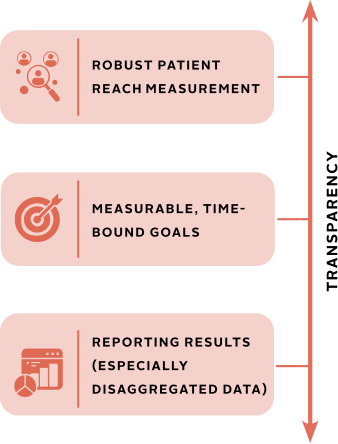
Measurable, time-bound product-related goals provide a basis for tracking progress and holding companies accountable for improving access. Reporting patient reach results – especially disaggregated data – makes progress visible and shows where further action is required. Transparency across all aspects of patient reach measurement, goal-setting and reporting ensures that information can be understood, compared and trusted.
Novartis demonstrates leading practice in this area overall through comprehensive patient reach measurement, clearly defined goals, regular public reporting on an increasingly disaggregated level and a high level of transparency across all aspects of its patient reach practices.
Underpinning Novartis' patient reach measurement is a standardised methodology applied across its portfolio. This establishes a consistent framework for defining its patient reach metrics, underlying equation, assumptions and limitations, ensuring a comparable model for estimating patient reach for products and countries where access efforts have been implemented.
At the same time, applying a standardised methodology uniformly across products and implementation settings may overlook product- and context-specific nuances, reducing the accuracy of resulting estimates. To address this, Novartis adapts specific assumptions and calculation parameters where appropriate. This is evident for products assessed in this report, although certain underlying details remain under NDA.
Through its standardised yet adaptable methodology, Novartis enhances the credibility of its patient reach figures, enabling stakeholders to interpret and compare results with greater confidence and trust. This provides a strong foundation for its broader patient reach efforts.
Without clearly defined product-related goals, patient reach estimates only give a snapshot of performance rather than a measure of progress. Defined long-term targets and timeframes provide companies and stakeholders with a way to assess whether access efforts are achieving their intended outcomes over time.
Novartis demonstrates this with its renewed goal to increase patient reach in low- and middle-income countries (LMICs) by 150% for its strategic innovative medicines by 2030. The goal includes a clearly defined multi-year target and timeframe that, combined with the company's robust approach for calculating patient reach, allow for meaningful evaluation of results against the goal.
Notably, earlier patient access goals were also linked to a sustainability-linked bond, with progress against these targets subject to independent external verification and financial consequences if they are not achieved. This created a clear incentive to deliver measurable improvements in patient reach.
Reporting patient reach figures helps determine whether meaningful steps have actually been taken in reaching underserved populations. However, not all reporting is equally informative. Disaggregating patient reach data by product, disease area, geography or population provides a clearer picture of where barriers to access persist.
Putting this into practice, Novartis reports patient reach at multiple levels. Publicly available reporting includes global aggregate figures and portfolio-level data, with separate reporting on innovative medicine and global health portfolio reach in LMICs. More granular data, including therapeutic area, disease, and product-level reach in specific countries, is currently shared under NDA.
Meaningful interpretation of patient reach data depends on openness around these figures. By being transparent about how numbers are calculated, the targets pursued and results achieved, companies can strengthen their credibility and help stakeholders translate patient reach data into actions that benefit underserved communities.
Transparency around how patient reach is calculated is one area where disclosure remains limited. All companies report a patient reach metric but only a quarter disclose all components of their methodologies, including the underlying equation, assumptions and limitations used to produce these figures (read more about these components on p.XX). Novartis, however, stands out by publicly disclosing all components, giving stakeholders a clearer understanding of how patient reach figures are derived.
Transparency also extends beyond methodology. Novartis publicly discloses detailed information about its patient reach goals and regularly reports progress against them. Although the most granular therapeutic- and product-level data remains available only under NDA, the company also makes disaggregated results publicly available for its innovative medicine goals and global flagship products.
Together, transparent methodologies, clearly defined goals and detailed reporting provide stakeholders with the context needed to interpret patient reach figures, assess company performance and determine where partnerships, investment and policy interventions could have the greatest impact on improving access to medicines.
Actually reaching patients with the products and care they need requires robust ways to measure the reach of access efforts, well-defined goals against which progress can be assessed, detailed reporting on that progress and transparency across each of these elements. Overall, Novartis demonstrates leadership in these building blocks and illustrates how they can be strengthened by other companies.
Adopting a standardised methodology while retaining sufficient flexibility to reflect product-specific characteristics and country contexts can improve the consistency and robustness of patient reach measurement. Complementing this with well-defined, time-bound goals establishes a clear basis for assessing progress. Publicly reporting patient reach results at increasingly disaggregated levels can help stakeholders identify remaining access gaps, assess whether underserved populations are being reached and monitor progress over time. Finally, greater transparency across patient reach measurement, goals and reporting would better equip stakeholders to interpret patient reach data and aligns with growing expectations for industry-wide transparency on access outcomes.
