10 November 2026
GLP-1 innovation is accelerating, but access to GLP-1s and insulin remains the real equity test
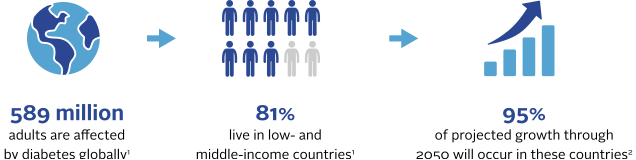
Diabetes affects an estimated 589 million adults globally, 81% of whom live in low- and middle-income countries (LMICs).1 With 95% of the projected growth in diabetes through 2050 expected to occur in these countries, it is critical to ensure that access to existing medicines be assured and expanded, and that any new treatment is developed with future access in LMICs* in mind. 2
* The term LMICs refers to all low- and middle-income countries in scope of the Index. Where referring specifically to the World Bank income group, “lower-middle-income countries” is written out in full. The terms LICs and UMICs refer to low-income countries and upper-middle-income countries, respectively, in line with the World Bank income group classification. This convention does not apply to the Report Cards.
GLP-1s make up the bulk of the diabetes research pipeline
The diabetes research and development (R&D) pipeline contains 25 projects across six companies – AstraZeneca, Eli Lilly and Company, Gilead, Novo Nordisk, Roche and Sanofi – with Lilly and Novo Nordisk covering approximately two-thirds. Innovation is concentrated around incretin and other metabolic hormone-based approaches for type 2 diabetes, comprising 18/25 (72%) of projects, many of which involve GLP-1-based mechanisms. These approaches act on hormone pathways that regulate blood sugar, appetite and metabolism and are also widely used to treat obesity.
Pipeline development is increasingly focused on improving on existing GLP-1 medicines, including through treatments designed to deliver greater or broader benefits, as well as oral formulations that could reduce reliance on injections. By contrast, innovation for type 1 diabetes (T1D) is more limited, representing 10/25 projects (40%). Sanofi is the only company with an active diabetes pipeline that doesn’t have a GLP-1 candidate in the pipeline, focusing solely on T1D.
Access plans cover about half of projects, but fall short on affordability and inclusion of low-resource settings
Among late-stage projects, 53% (10/19) have an access plan in place; however, nearly all of these plans (7/10) focus only on preparing for registration in an average of four countries. Only 20% (2/10) of access plans include equitable pricing measures, while the geographic reach remains narrow, covering mostly emerging markets. This is notable given the significant burden of diabetes in LMICs, where barriers to treatment remain substantial, and means that, even where access plans are in place, they may do little to address affordability barriers faced by lower-income populations within these markets. More targeted approaches are therefore needed to ensure that access planning translates into meaningful improvements in access for underserved populations. As the global diabetes burden continues to rise, limited planning for affordability and access in lower-resource settings risks widening the gap between where new treatments are developed and where the need for them is greatest.
GLP-1s: Largely out of reach for people in low- and middle-income countries
As many LMIC health systems already struggle to provide affordable diabetes care, it’s unsurprising that access to GLP-1 medicines has so far been very limited in these countries. More affordable GLP-1s could give patients access to newer treatment options that are currently out of reach. So far, however, company-led efforts to expand access have been limited and uneven, with initiatives concentrated in a small number of commercially interesting middle-income markets. Meanwhile, low-income populations have had limited access to GLP-1 medicines, with more affordable generic versions only now beginning to enter some markets as key patents on older products expire.
Lilly launched Mounjaro® (tirzepatide) in India in March 2025 and, in October 2025, partnered with Cipla to expand distribution through a second-brand strategy beyond the major cities where Lilly already had a presence.3,4
Novo Nordisk is also using second-brand partnerships to broaden access to semaglutide – a subcategory of GLP-1 medicines – including through Extensior®, a second brand of Ozempic® introduced in Brazil, India and South Africa.5,6,7It has expanded registration of its GLP-1 medicine Ozempic®/ Extensior® (semaglutide) from 26 to 56 countries since the previous Index, and has provided evidence of supply in 26 of these, spanning upper- and lower-middle-income countries.
These examples demonstrate that access efforts for GLP-1s remain selective, market-specific and largely commercially oriented. Furthermore, in the absence of price and volume data, their impact and patient reach remain unclear.
Generics will shift the GLP-1 landscape
Generic competition is beginning to emerge for these GLP-1s. Following the expiry of Novo Nordisk’s semaglutide patent in South Africa, Sun Pharma received approval for its generic semaglutide there in July 2026 after securing earlier approval in India.8 As semaglutide patents expire in additional countries from 2026 onwards, greater generic competition will lower prices and improve access. However, generic versions will initially also prioritise higher-income markets, meaning patent expiry alone will therefore not automatically guarantee access in low-resource settings. How widely generic GLP-1s are registered and marketed will therefore be an important indicator of their potential reach. Beyond registration, financing, supply, manufacturing capacity and companies’ willingness to serve lower-income markets will determine whether these medicines reach patients at scale.
These emerging challenges sit alongside persistent gaps in insulin, which remains essential for people with T1D.
Insulin: Persistent gaps risk being compounded by evolving pipelines
Access challenges are not confined to new therapies: more than a century after insulin’s introduction, affordable and reliable access remains uneven. This also varies by insulin type, with human insulin generally more affordable and more widely available in LMICs than newer analogue insulins. Assessing access to existing insulin products therefore provides an important counterpoint to progress in the R&D pipeline, showing the extent to which Lilly, Novo Nordisk and Sanofi – which collectively account for more than 90% of the global insulin market – are translating their status as key players in diabetes care into access for patients in LMICs.9
How do the three biggest insulin manufacturers compare?
All three manufacturers have developed initiatives over the past decade to improve insulin access in LMICs, including affordability and pricing approaches, inclusive business models and technology transfers – but with generally limited evidence of impact. At the same time, some companies are slimming down their insulin portfolios and scaling back production of older products and formulations.10 This could further limit the range of insulin products available, particularly in LMICs where access is already constrained, making it increasingly important to maintain and expand reliable and affordable sources.
Against this backdrop, the following provides examples of the approaches each of the three biggest insulin manufacturers is taking and the available evidence of their reach for a selection of insulin products assessed by the Index.
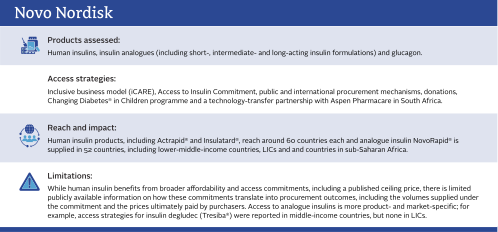
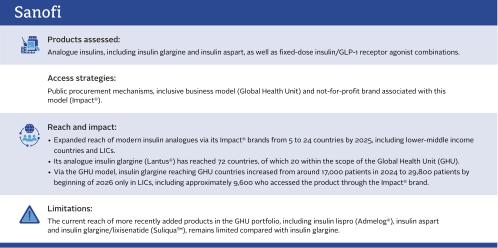
Sanofi shows more recent evidence of expansion into lower-resource settings, particularly for analogue insulin and through its Global Health Unit (GHU). Meanwhile, Novo Nordisk combines a broad insulin portfolio with several complementary access mechanisms covering both human and analogue insulin. Patient reach in lower-resource settings seems greater for human insulin but has never been supported by exact data on price and volume. Alongside these company-led approaches, partnerships to localise insulin production in Africa are beginning to add another route to expanding availability, as illustrated by Lilly’s partnership with EVA Pharma and Novo Nordisk’s partnership with Aspen Pharmacare. However, evidence that this has translated into broad patient access remains limited.
Taken together, these initiatives show progress, but none provide comprehensive coverage across insulin types and countries and very few exact data are available. This gap may become more significant as manufacturers shift portfolios, phasing out some older insulin products and moving manufacturing capacity toward newer products. Considering that 90% of adults with untreated diabetes live in LMICs, this points to a dual challenge: expanding access to newer therapies and safeguarding access to older, affordable insulin products.11
As innovation accelerates around newer insulins and GLP-1 therapies, companies should not only expand access to new products where they offer additional clinical value but also safeguard sustainable access to established essential treatments on which many health systems and patients continue to depend. Greater assurance and transparency regarding the continuation of these efforts would provide a clearer indication of the extent to which global access to essential diabetes treatment is reflected in companies’ broader access and investment priorities, alongside the development and commercialisation of newer therapies.
What’s next?
It is crucial to maintain reliable and affordable access to human insulin while expanding access to analogue insulins where they provide additional clinical benefit, particularly for populations currently reliant on older or more limited treatment options.
Companies should systematically identify and prioritise populations least likely to benefit from existing insulin access approaches, such as people living in LICs, children and young people with T1D and populations facing barriers to affordable and reliable insulin supply.
Companies should ensure that new diabetes technologies do not exacerbate existing inequalities by integrating comprehensive access planning and developing affordable delivery models for newer insulins, GLP-1 therapies, and glucose-monitoring technologies beyond richer countries and populations.
Manufacturing partnerships, such as those with EVA Pharma and Aspen, can help address persistent access gaps in underserved markets by expanding regional production, strengthening supply security and potentially improving affordability. However, reporting the outcomes of these partnerships, including price, geographical coverage and volumes, is crucial to measure whether they lead to sustained improvements in insulin availability.
Companies should develop clear and measurable commitments to maintaining supply and improving affordable access to insulin products across LMICs, including more granular targets and KPIs against which progress can be assessed. Without such transparency, the extent and real impact of company commitments will remain difficult to assess.
References:
International Diabetes Federation. Diabetes global report 2000-2050. International Diabetes Federation; 2025. https://diabetesatlas.org/data-by-location/global/
International Diabetes Federation. IDF Diabetes Atlas. 11th ed. International Diabetes Federation; 2025. https://media.idf.org/media/uploads/sites/3/2025/10/IDF_Diabetes_Atlas_11th_Edition_2025_WEB.pdf
Sadam R. Eli Lilly launches weight-loss drug Mounjaro in India, beats Novo Nordisk to major market. Reuters. Published March 21, 2025. https://www.reuters.com/business/healthcare-pharmaceuticals/eli-lilly-launches-weight-loss-drug-mounjaro-india-after-drug-regulator-approval-2025-03-20/
Cipla. Lilly and Cipla sign a distribution and promotion agreement for Yurpeak® (tirzepatide) in India. Cipla. Published October 23, 2025. https://www.cipla.com/press-releases-statements/lilly-and-cipla-sign-distribution-and-promotion-agreement-yurpeakr
Silva, C. Brazil Approves Its First Locally Made Generic of Semaglutide, the Ozempic Weight-Loss Drug. The Rio Times. Published August 17, 2026. https://www.riotimesonline.com/brazil-approves-its-first-locally-made-generic-of-semaglutide-the-ozempic-weight-loss-drug/
Shukla A. Abbott partners Novo Nordisk India to launch Extensior for Type 2 Diabetes in India. Business Upturn. Published February 27, 2026. https://businessupturn.com/sectors/health/abbott-partners-novo-nordisk-india-to-launch-extensior-for-type-2-diabetes-in-india/
Adegboyega A. Ozempic maker launches cheaper copy in Africa’s largest pharma market after court blocks unregistered Ozempic copies. Business Insider Africa. Published July 18, 2026. https://africa.businessinsider.com/local/markets/ozempic-maker-launches-cheaper-copy-in-africas-largest-pharma-market-after-court/np2d3cv
Dar UA. Sun Pharma receives approval to launch generic semaglutide in South Africa. Business Standard. Published July 15, 2026. https://www.business-standard.com/companies/news/sun-pharma-south-africa-generic-semaglutide-approval-glp-1-diabetes-drug-126071500190_1.html
Knox, R. Insulin insulated: barriers to competition and affordability in the United States insulin market. Journal of Law and the Biosciences. 2020;7(1). doi:10.1093/jlb/lsaa061
World Health Organization (WHO). Expansion of the Insulin Master File Procedure to Insulin Analogues. WHO Prequalification of Medical Products. Published March 25, 2026. https://extranet.who.int/prequal/news/expansion-insulin-master-file-procedure-insulin-analogues
World Health Organization (WHO). Urgent action needed as global diabetes cases increase four-fold over past decades. World Health Organization. Published November 13, 2024. https://www.who.int/news/item/13-11-2024-urgent-action-needed-as-global-diabetes-cases-increase-four-fold-over-past-decades
