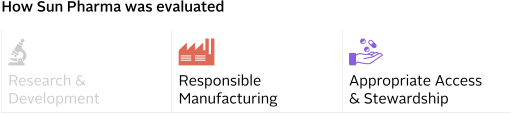
Performance in the 2026 Benchmark
Low-performing. Sun Pharma has opportunities to improve in Responsible Manufacturing, reporting an environmental risk management strategy aimed at mitigating AMR at its own but not at its suppliers’ sites. It also has potential to strengthen performance in Appropriate Access & Stewardship, where its efforts are mixed. Although it performs well in its efforts to mitigate stockouts and shortages of its products in LMICs, it registers its products in fewer countries than other assessed generic medicine manufacturers and implements access and stewardship strategies for less than half of the products assessed.
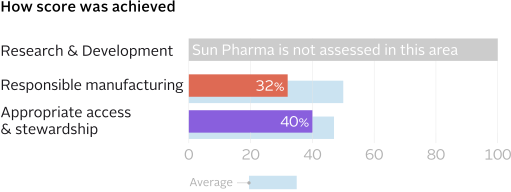
Opportunities for Sun Pharma
Expand appropriate access to paediatric formulations of its antibacterial and antifungal medicines. Sun Pharma registers its off-patent medicines in an average of eight LMICs, yet it only registers child-friendly formulations of its Access antibiotics in India. It can bridge this gap and expand access to paediatric formulations by registering them more widely and implementing appropriate access strategies in at least the same countries where it already registers the corresponding adult formulations.
Expand patient reach monitoring to all off-patent antibacterial and antifungal medicines. Sun Pharma reports the number of patients reached for one on-patent and one off-patent medicine only but does not do so consistently across its off-patent portfolio. It can improve its approach to tracking patient reach – which is essential to enable measurement of appropriate access and support the responsible use of its medicines – by tracking patient reach consistently across its entire portfolio, at both the product- and country-level.
Strengthen its responsible business practices. Sun Pharma does not decouple incentives for its sales agents from sales volume targets. It can start ensuring its sales practices do not incentivise misuse or overuse of its antibacterial and antifungal medicines by at least beginning to decouple incentives from sales volume targets or stop deploying sales agents for these medicines altogether. Moreover, Sun Pharma can strengthen its public policy governing interactions with healthcare professionals (HCPs), and thereby address appropriate use of its antimicrobials, by including provisions to mitigate potential conflicts of interest – specifically between employees and HCPs; limit transfers of value and ensure these are made at fair market value.
Ensure compliance with discharge limits directly in wastewater at supplier sites and improve transparency on antibacterial waste management practices. Sun Pharma reports 100% compliance with discharge limits directly in the wastewater for its own sites under Zero Liquid Discharge conditions, but it does not report supplier site compliance. To further safeguard AMR risk from antibacterial manufacturing, it can publicly report compliance with discharge limits directly in wastewater for its suppliers’ sites and require supplier compliance through contractual provisions – a step beyond its current practice of setting discharge limits in receiving waters – in line with the ‘stringent’ WHO guidance. It can also publicly report the quantification methods used.
Changes since November 2023 update report on previous Benchmark opportunities
In 2024 in India, Sun Pharma launched tedizolid phosphate (STARIZO®) – a new antibiotic targeting acute bacterial skin and skin structure infection – under a licensing agreement with MSD.
Sales & Operations
Therapeutic areas: Anti-infectives, cardiology, dental, dermatology, diabetes, gastroenterology, gynaecology, nephrology, neurology, oncology, ophthalmology, psychiatry, respiratory diseases, urology
Product categories: Generic medicines & biosimilars
Investments in AMR: No notable investments identified.
M&A news: None identified in the antibacterial and/or antifungal sectors
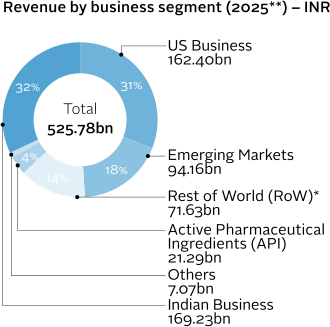
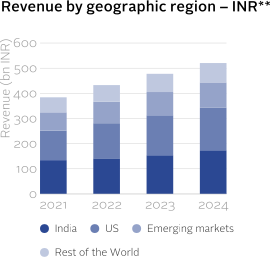
*RoW includes Western Europe, Canada, Israel, Japan, Australia, New Zealand and other markets.
**In India, companies follow a financial year from April 1 to March 31, so their annual turnover and revenue figures (shown for 2025) may not align with other companies in the AMR Benchmark that report on a calendar-year basis (January– December) for which 2024 figures are shown.
Sample of portfolio assessed by the Benchmark
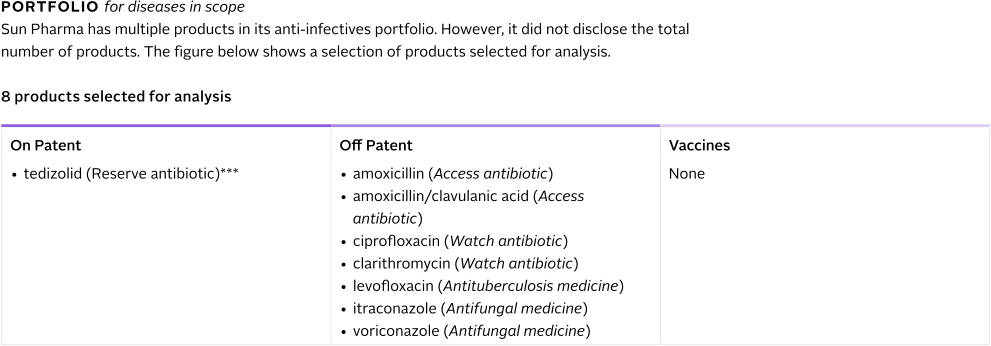
***Sun Pharma reports that other manufacturers are in the process of regulatory approval for tedizolid in India.
Performance by Research Area
Responsible manufacturing
Low-performing. Reports an environmental risk management strategy aimed at mitigating AMR risk at its own sites, but not at its suppliers’. It reports compliance with discharge limits across all its own sites. For its suppliers, it does not report the level of compliance achieved and does not incorporate AMR provisions into contracts. It does not publicly disclose the quantification methods implemented, or the level of compliance achieved across its supply chain.
Basic environmental risk management to mitigate AMR at its own sites but not suppliers’; initial stages of discharge quantification, tracks compliance of antibacterials with discharge limits for its own sites. Sun Pharma reports adopting management and treatment practices for wastewaters and solid wastes from antibiotic manufacturing to minimise the impact of antibacterial discharge to the environment based on the PSCI principles. This includes mass balance estimation and complying with discharge limits based on PNECs. The company reports initiating the quantification of the concentration of antibiotics in wastewaters for its own sites, but no details on the quantification methods implemented are known. It reports implementing ZLD systems at all its antibacterial manufacturing sites, therefore complying with PNECs outlined in the PSCI guidance. The company does not report reviewing antibacterial discharge at its supplier sites. Therefore, it is unclear how many antibacterial products meet discharge limits at its supplier sites. Sun Pharma reports that its wastewater is treated in an internal wastewater treatment facility and its solid waste is sent to an incineration site for disposal.
No publicly available information on environmental risk management to mitigate AMR. Sun Pharma publicly reports implementing ZLD at 16 of its global manufacturing sites. However, it does not publicly report quantification of antibacterial discharge levels at its own sites, or its suppliers’ sites, and therefore does not publicly disclose audit results, measured discharge levels, or the names and locations of manufacturing sites for each antibacterial product.
Appropriate Access & Stewardship
Low-performing. Performs well in ensuring continuous supply by implementing strategies to mitigate stockouts and shortages. Its performance on stewardship is inconsistent, as appropriate use is considered in its governance of interactions with healthcare professionals, but not across its businesspractices. Sun Pharma can improve its registration coverage and implementation of access and stewardship strategies. It registers its products in less countries on average compared to peers and only implements specific strategies for four out of the nine products assessed.
Sun Pharma registers its on- and off-patent medicines in fewer countries than its peers.
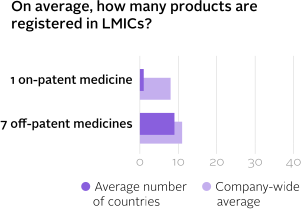
Sun Pharma registers its on-patent medicine, tedizolid, in India and its off-patent medicines in 9 countries.* Of all the off-patent medicines assessed, 2 paediatric formulations (for 2 different medicines) are registered in just 1 country in total. Its on- and off-patent Reserve antibiotics and medicines targeting MDR-TB are registered in 2 countries, including 1 country where the corresponding disease burden is high. Sun Pharma does not report engaging in any mechanism to facilitate registrations for the products selected for analysis.
*All numbers in this statement are expressed as an average of the products selected for analysis and refer to registrations in the 113 countries in scope for ‘access metrics’.
Average performance, with limited access and stewardship strategy for the only on-patent product assessed, tedizolid (STARIZO®), but robust patient reach methodology. Sun Pharma supplies its antibiotic, tedizolid, in India, but the reported access strategy lacks detail and primarily relies on Sun Pharma’s established distribution and supply networks in the country. The company calculates patient reach by considering the number of units sold and the units required to complete a treatment course and reports the number of patients reached in India during the period of analysis. As part of its stewardship strategy, Sun Pharma shows efforts to ensure the availability of susceptibility tests, enabling HCPs to make rapid diagnoses and ultimately safeguard against overuse or inappropriate use of the product.
Below-average performance, with limited evidence of implementing access and stewardship strategies for 3 of 7 off-patent/generic products assessed. Sun Pharma reports access strategies for 3 products assessed: levofloxacin, amoxicillin-clavulanic acid and clarithromycin. It reports that levofloxacin is available in the private sector in India via private clinics and pharmacies, but no details of the strategies for amoxicillin-clavulanic acid and clarithromycin are reported. It also reports using a methodology to measure patient reach and provides the number of patients reached with levofloxacin in India, but no patient reach data is reported for amoxicillin-clavulanic acid or clarithromycin. However, Sun Pharma shows efforts in implementing stewardship strategies for these 2 products, focusing on initiatives for their responsible promotion, including the development of formulations that match approved dosage amounts to encourage appropriate use.
Strong efforts to mitigate stockouts/shortages. Some reported evidence of systems to ensure product quality. Sun Pharma implements demand planning and data sharing by analysing historical market trends and internal sales data. It implements a forecasting horizon of 3 months and shares demand forecasts with internal and external stakeholders. It maintains buffer stocks of its APIs and products based on internal norms and forecasts. It implements an automated inventory management system to identify and mitigate supply continuity risks. It also implements supplier diversification initiatives through engaging with multiple upstream suppliers and sourcing 83% of its procurement from local suppliers. Sun Pharma mitigates substandard and falsified medicines by verifying suppliers through GMP audits and reports cases to relevant stakeholders. However, it does not disclose any additional quality measures implemented in countries with evolving regulatory systems.
Includes elements to address appropriate use in its public policy, but not in its sales practices. Sun Pharma does not decouple incentives for its sales agents from sales volume targets and it does not report linking incentives to qualitative measures. Sales volume targets are set at the individual level. Through its global public policy, Sun Pharma ensures ethical interactions with HCPs, and for certain interactions it requires a defined legitimate need. This includes interactions where HCPs are hired to provide services for Sun Pharma. It voluntarily discloses information on transfers of value publicly in the UK. While Sun Pharma’s sales practices do not apply to third parties working on its behalf, its public policy does.
