Performance in the 2026 Index
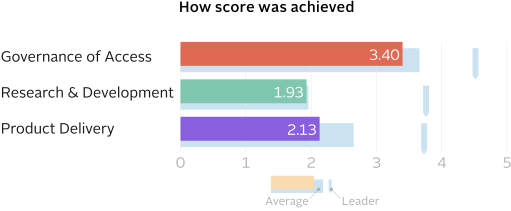
13th place. Johnson & Johnson performs below average overall. Governance of Access and Product Delivery are its weaker areas, reflecting limited reporting on patient reach and disclosure on registration and access strategies. It performs better in research and development (R&D), with access plans across late-stage projects, although these are limited in scope.
Opportunities for Johnson & Johnson
Ensure comprehensive access plans cover all late-stage mental health and Alzheimer’s disease candidates. Johnson & Johnson has access plans for 68% of its late-stage candidates, with these plans largely limited to a commitment to register products where clinical trials are conducted. However, only three of the eight late-stage neuroscience candidates currently have clinical trials ongoing in countries in scope. The company can expand the geographic footprint of these trials by including low- and middle-income countries (LMICs), while disclosing affordability plans for these projects.
Expand oncology access strategies and strengthen evidence of impact. Johnson & Johnson has access strategies for its five oncology products assessed, but none extend to low-income countries (LICs). Although most products are supplied in upper- and lower-middle-income countries, information on how the access strategies are implemented is limited, and no evidence of patient reach or outcomes was identified for any of the products. It can strengthen access by extending strategies to more countries with high unmet need and provide clearer evidence of how they translate into patient reach, including for ibrutinib (Imbruvica®), indicated for leukaemia and non-Hodgkin lymphoma.
Advance bedaquiline (SIRTURO®) studies to address critical tuberculosis (TB) needs in LMICs. Despite a shift away from infectious disease R&D, Johnson & Johnson can continue progressing its remaining bedaquiline (SIRTURO®) pipeline projects, such as a long-acting injectable formulation, while addressing remaining paediatric treatment gaps, including in children under two years of age. As these projects advance, it can further develop and expand access plans to support availability for people with TB in countries with a high burden of multidrug-resistant TB.
Disclose a systematic process for measuring patient reach. Johnson & Johnson did not provide evidence of a patient reach process. It can publish details of its patient reach process, including the underlying equation, metrics, assumptions and limitations. It could strengthen patient reach reporting by regularly publishing disaggregated figures, including by geographic region and/or country income level, and disclosing the outcomes of its product-specific access strategies.
Changes since the 2022 Index
In April 2025, completed the acquisition of Intra-Cellular Therapies, adding lumateperone (Caplyta®) to its portfolio. Lumateperone (Caplyta®) is an oral therapy approved by the United States Food and Drug Administration for the treatment of schizophrenia in adults and for depressive episodes associated with bipolar I or II disorder.
Through J&J CareCommunity, supported the Take Charge Against TB initiative in India in collaboration with PATH, TB Alert India and the National TB Elimination Programme. The programme trained more than 1,500 community health workers across 130 communities in Delhi, Hyderabad and Pune to improve TB symptom screening, address stigma and strengthen referral pathways. The initiative reached more than 16mn people during its pilot phase.
In December 2025, completed the acquisition of Halda Therapeutics and its platform for developing oral, targeted therapies for solid tumours, including prostate cancer. The acquisition also includes earlier-stage candidates for breast, lung and other tumour types.
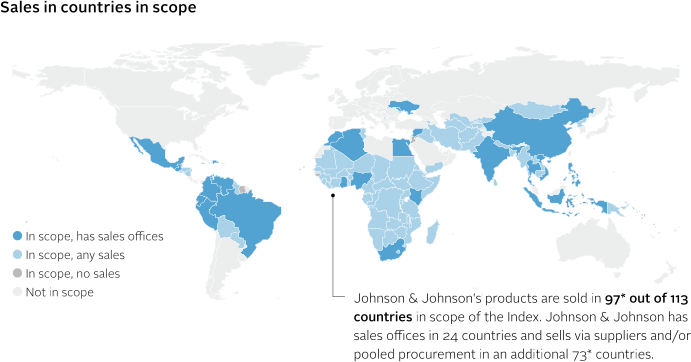
* For the 2026 iteration, Johnson & Johnson declined to submit data to the Access to Medicine Index.
Sales and operations
Therapeutic areas: Cardiopulmonary, communicable diseases, immunology, neuroscience, oncology, pulmonary hypertension
Product categories: Innovative medicines, MedTech
M&A news: In 2024, Johnson & Johnson acquired Yellow Jersey Therapeutics, Proteologix and V-Wave for USD 1.25bn, an initial USD 850mn and up to USD 1.7bn, respectively. The company acquired Intra-Cellular Therapies, Inc. for USD 14.6bn and Halda Therapeutics OpCo for USD 3.05bn in 2025. It also divested Stugeron to Dr. Reddy's Laboratories for INR 445 crore. In 2026, it acquired Firefly Bio for USD 1bn.
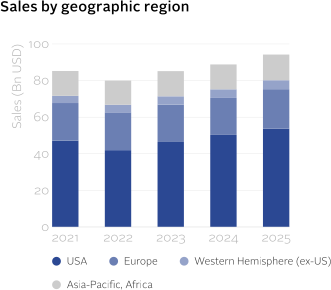
Sales by segment (2023) – in USD | |
Innovative medicines | 60.40 bn |
MedTech | 33.79 bn |
Total | 94.19 bn |
Sample of pipeline and portfolio assessed by the Index
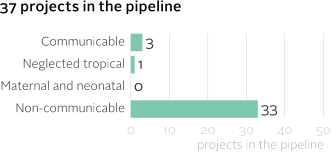
PIPELINE for diseases in scope
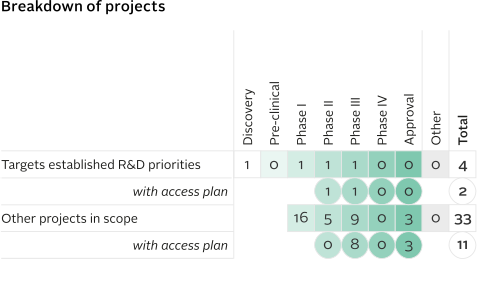
Johnson & Johnson has 37 R&D projects in scope, 4 of which target priority diseases, focusing on TB (3) and leprosy (1). The remaining 33 R&D projects target other diseases in scope, including cancer (22), depressive disorders (4) and cardiovascular diseases (3). Of its 37 R&D projects, 19 are in late-stage development, with evidence of access planning for 68% (13/19) of these.
PORTFOLIO as selected for analysis by the Index
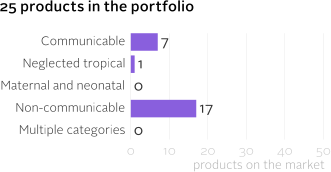
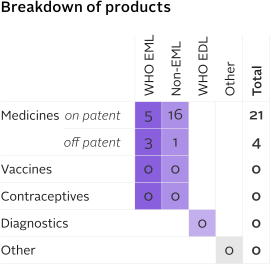
Johnson & Johnson has 25 medicines in scope, 8 of which are listed on the WHO EML. Most of its medicines are on patent (21). Its communicable disease medicines are indicated for HIV (6) and TB (1), while its NCD medicines include treatments for cancer (9) and diabetes (2). It also has 1 medicine indicated for the neglected tropical disease soil-transmitted helminthiasis.
Performance breakdown
Governance of Access
14th place. Johnson & Johnson is among the lower-performing companies in Governance of Access. It has board-level accountability, access-linked incentives for senior executives and regional managers, and robust controls against non-compliant or corrupt conduct. However, it does not disclose a systematic, company-wide approach to measuring patient reach. No patient reach goal has been identified, and patient reach is reported only for a limited number of products.
Has clear board-level accountability for access to medicine via its Regulatory Compliance & Sustainability Committee. This committee oversees access-related strategies and reviews related matters at least annually. Johnson & Johnson incentivises senior executives and regional managers to act on access to medicine objectives. No evidence of training or awareness activities related to access-to-medicine implementation was disclosed publicly or to the Index.
Shows strong commitment to responsible sales and promotional practices. Johnson & Johnson sets individual-level targets for sales representatives, but incentives are not solely based on sales volume. It also incentivises sales representatives on qualitative performance indicators such as technical knowledge and service quality to healthcare professionals. It has a global policy on ensuring ethical interactions with healthcare professionals and declares that transfers of value to healthcare professionals (e.g., payments for facilitating scientific workshops) are made at fair market value. It publicly discloses information on such payments in countries in scope if required by law or local regulation.
Has a robust set of controls to promote ethical conduct and mitigate risk to ensure that governance efforts are not undermined by non-compliant or corrupt activities. Johnson & Johnson performs strongly in this respect. It has policies to mitigate non-compliance risks, including processes to ensure third-party compliance with company standards, fraud-specific risk assessments and region or country risk-based assessments. It has an ethical decision-making framework for employees and provides related training annually. No breaches in countries in scope were found in the period of analysis.
Publicly supports the Doha Declaration on TRIPS and Public Health. However, it expresses reservations on some provisions of TRIPS flexibilities, namely compulsory licensing. The company states that compulsory licensing should be used in certain limited circumstances.
Performs poorly in its approach to measuring and reporting on patient reach. Johnson & Johnson does not have a systematic, company-wide approach to measuring patient reach, and no methodological components have been shared publicly or with the Index. No measurable, time-bound product-related patient reach goal has been identified. Patient reach is reported annually for a limited number of products.
Research and Development
10th place. Johnson & Johnson is a middle-performing company in R&D. Its small priority disease pipeline has access plans in place for all late-stage projects, although these are largely limited to registration commitments. Access planning across its pipeline addressing other diseases is similarly limited, with plans focused mainly on emerging markets. It discloses disaggregated R&D investment data to global health organisations, but not publicly.
Small-sized pipeline addressing priority diseases in scope, compared to peers, consisting of 4 projects, with access plans identified for 100% (2/2) of its late-stage R&D projects. Access plans are limited to a commitment to register in countries where clinical trials are conducted, with these trials taking place in LMICs and LICs, and the inclusion of special populations. Beyond this, no specific access planning measures were identified.
Average-sized pipeline addressing other diseases in scope, compared to peers, consisting of 33 projects, with access plans identified for 65% (11/17) of its late-stage R&D projects. Access plans are limited to a commitment to register in countries where clinical trials are conducted, with these trials taking place predominantly in emerging markets, and the inclusion of special populations. Beyond this, no specific access planning measures were identified.
Does not publicly disclose R&D investment data disaggregated by disease category, product type or phase of development. However, Johnson & Johnson does disclose anonymised disaggregated R&D investment data to Impact Global Health.
2 of 3 R&D capacity-building initiatives included for analysis meet all Good Practice Standards (GPS). One example is the Clinical Trials Community Africa Network. Johnson & Johnson is 1 of the parties involved in the initiative, which aims to build clinical trial capacity in sub-Saharan Africa.
Product Delivery
15th place. Johnson & Johnson is among the lower-performing companies, with limited available evidence of registration and access strategy implementation across its products. Capacity building performance is stronger, with all manufacturing initiatives meeting all GPS. It also engages in technology transfers (TTs) and mechanisms to ensure continuous supply in low- and middle-income countries (LMICs).
Performance on product registration is inconclusive. Johnson & Johnson did not disclose registration data to the Index. However, there is evidence in the public domain that indicates it registers at least some of its products in some countries in scope.
Supplies 2 products via supranational agreements, but no evidence of outcomes. For the 2 products assessed, Johnson & Johnson provides evidence of supply via supranational agreements during the period of analysis. For 1 product indicated for HIV/AIDS, no further details of the agreement, or evidence of supply in countries not eligible for the agreement have been disclosed. The other product, bedaquiline oral tablet (Sirturo®), indicated for TB, is supplied via Stop TB’s Global Drug Facility (GDF) supranational mechanism. The company has granted GDF a licence to tender, procure and supply generic versions of bedaquiline in the majority of LMICs and it does not enforce any patents for this product in 134 LMICs. For both products, it has not disclosed, either publicly or to the Index, the outcomes of these strategies.
Access strategies for its HCP-administered products, with limited geographic scope and no data on outcomes reported. For 3 of the 5 products analysed, Johnson & Johnson provides access strategy examples in LMICs. For 1 product, it also provides evidence of a strategy in an upper-middle-income country (UMIC). However, no evidence of product-specific access strategies in LICs has been disclosed either publicly or to the Index. In the examples assessed, the company demonstrates efforts to address affordability, by securing public reimbursement or implementing additional discounts. Pricing strategies are also complemented by educational and awareness-raising initiatives for most examples. It has not disclosed, either publicly or to the Index, the outcomes of these strategies.
Access strategies for some of its self-administered products, but no data on outcomes reported. For 3 of the 5 products selected for analysis, Johnson & Johnson provides access strategy examples in UMICs and LMICs. For 1 product, it also provides evidence of a strategy in an LIC. For 2 products, it demonstrates efforts to address affordability by securing public reimbursement in UMICs and implementing patient assistance programmes in LMICs. For only 1 pricing strategy example, it provides evidence of complementary educational and capacity-building initiatives. For the 3rd product, it provides access strategy examples in all 3 country income classifications (UMIC, LMIC, LIC), but access is limited to the private sector. has not disclosed, either publicly or to the Index, product-specific access strategies for the remaining 2 products, nor the outcomes of any of its strategies.
Publicly commits not to enforce patents on only 2 products. Johnson & Johnson publicly commits not to enforce patents on bedaquiline (Sirturo®) in 134 LMICs, and darunavir (Prezista®) in sub-Saharan Africa and LDCs. The darunavir policy was later expanded to include paediatric formulations in additional countries.
Publicly discloses product patent status for countries in scope. Johnson & Johnson publicly discloses patent information for small molecules in scope via the Pat-INFORMED database, including information such as filing date, grant number, grant date and jurisdiction.
1 non-exclusive voluntary licensing agreement for an on-patent compound, but terms not publicly disclosed. Johnson & Johnson has 1 voluntary licence for the HIV treatment rilpivirine; however, the terms of the licence are not publicly available.
All 5 manufacturing capacity-building initiatives included for analysis meet all GPS. For example, Johnson & Johnson is transferring technology to a manufacturer in 1 country in scope to support secondary packaging for 1 of its oncology products. The transfer includes training, expertise and pharmacological data.
2 of the 3 supply chain capacity-building initiatives included for analysis meet all GPS. For example, Johnson & Johnson is a member of the NTD Supply Chain Forum, a collaboration that strengthens supply chains for neglected tropical disease medicines and diagnostics by bringing together WHO, governments, NGOs, donors, logistics providers and pharmaceutical companies.
1 of the 2 health system strengthening initiatives included for analysis meets all GPS. Johnson & Johnson is engaged in nursing workforce support initiatives across multiple LMICs, including Brazil and Kenya. The initiatives aim to support nurses through education, leadership development, innovation and career opportunities.
No evidence of new or existing IP-sharing agreements that meet the inclusion criteria.
Publicly commits to continuing its long-term donation programme to support the control of soil-transmitted helminthiasis. Johnson & Johnson commits to donating mebendazole (Vermox® Chewable) through 2030 in endemic countries.
Fulfils all 3 mechanisms to ensure continuous supply in LMICs and is involved in local manufacturing at its own sites in countries in scope and demonstrates involvement in TTs. These TTs are designed to improve patient access, with ongoing support to the manufacturer. For example, Johnson & Johnson is transferring technology to produce a product indicated for HIV to manufacturers in a country in scope to supply the local market.
Has a procedure for reporting substandard and falsified medicines in countries in scope. Johnson & Johnson reports cases to national or local regulatory authorities within 5 days. It provides evidence of shortened reporting timeframes for cases that only require visual inspection for confirmation.
No evidence of inclusive business models that meet all inclusion criteria.