Featured
Key findings
Companies step up access planning for pipeline products, but progress lags for non-communicable diseases
10 November 2026
10 November 2026
The 2026 Access to Medicine Index highlights an industry at a crossroads. Access to medicine is becoming more deeply embedded in company operations, from long-term strategies and executive-level engagement to access planning during product development. But alongside these developments, persistent barriers remain. Research and development (R&D) pipelines addressing priority diseases are shrinking, and despite promising products being registered, licensed and delivered, the geographic scope of access efforts remains limited, particularly in countries with the greatest needs. At the same time, declining public disclosure makes it increasingly difficult to assess the impact of companies’ efforts.
The following sections provide an overview of company performance across the Index’s three Technical Areas: Governance of Access, Research & Development (R&D) and Product Delivery, drawing on findings from the 2026 assessment.
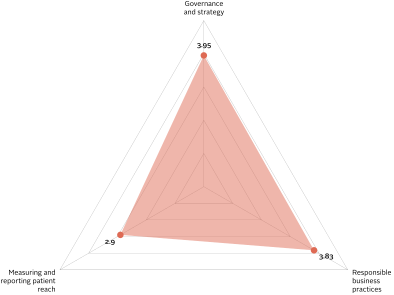
Governance of Access remains the strongest-performing Technical Area. In terms of board-level accountability, 17 out of 20 companies have direct board-level accountability for access to medicine strategies and initiatives. The industry continues to progress in responsible business practices, with two additional companies decoupling sales representatives’ bonuses from sales targets, bringing the total to 20 companies.
The 2026 Index strengthens expectations for measuring and reporting patient reach, with 12 companies meeting the new standard for systematically measuring the number of people reached with their products, with 12 companies meeting this new standard.
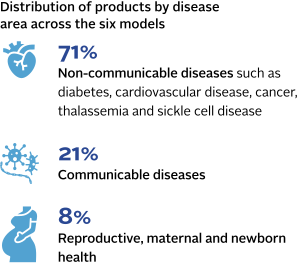
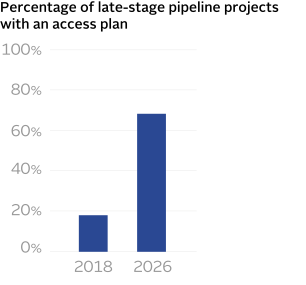
The 2026 Index shows a continued shift away from priority R&D – product development targeting diseases with the greatest unmet need – with the number of companies involved in R&D for priority diseases falling to its lowest level since 2018. Most priority R&D activity remains concentrated on a limited subset of conditions, such as HIV, tuberculosis and malaria, leaving 34 priority diseases entirely unaddressed. Access planning performance remains largely unchanged across the industry since the previous Index, with approximately three out of ten projects not covered by any access plans. Companies continue to develop stronger access plans for communicable diseases and neglected tropical diseases, while access planning for non-communicable diseases continues to lag, despite their rising burden in low- and middle-income countries (LMICs). Across all projects assessed, 69% (245/357) have an access plan in place, with a higher proportion of plans in Phase III (85%) compared to Phase II (51%). The geographic reach of access plans remains limited, predominantly targeting upper-middle-income countries, with only six countries in scope included in these plans, on average. More than half the companies (14/20) engage in R&D capacity buidling initiatives aimed at reducing skill gaps and increasing R&D capacity needs.
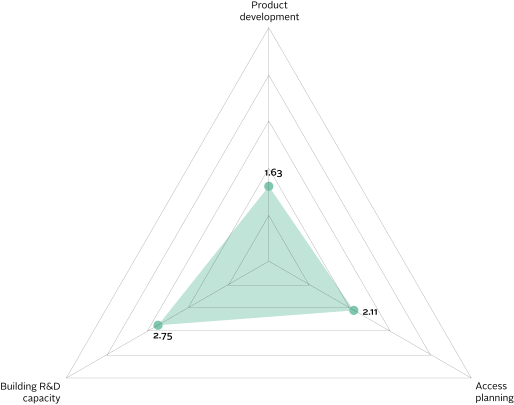
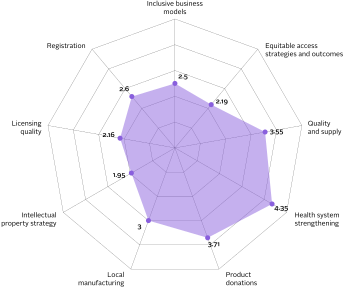
Companies continue to perform strongly in capacity building, with all 20 companies implementing health system strengthening initiatives seeking to address local needs, and most investing in local manufacturing and supply chain capabilities. In other areas, performance varies. In product registration, around half of the newer products assessed (56%) are not registered in any of the countries with the highest burden of disease, highlighting a persistent gap between newer products’ availability and public health need. Access strategies and outcomes show limited progress in geographic coverage, especially in low-income countries, despite some companies showing efforts to consolidate or expand existing approaches. Voluntary licensing activity continues to drive access among a subset of companies, with two new agreements signed, and one existing agreement expanded. Companies active in neglected tropical diseases continue to perform strongly on long-term donation programmes. However, performance on intellectual property strategies has declined marginally, reflecting reduced transparency in some company commitments not to enforce patents in LMICs.