Performance in the 2026 Benchmark
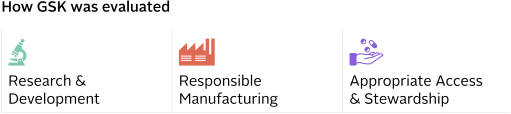
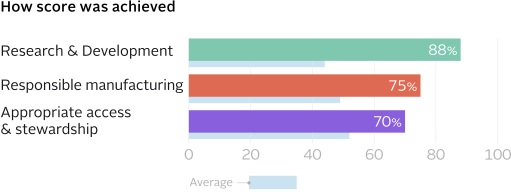
Leads among large research-based companies. GSK performs strongly across all Research Areas. It shows Best Practice by maintaining its pipeline size, ensuring ethical interactions with healthcare professionals through its public policy and engaging suppliers to support their wastewater management practices. Its leading position in R&D is evidenced by the largest pipeline of all companies, including the most pipeline projects targeting ‘critical’ and ‘high’ priority pathogens. In Appropriate Access & Stewardship, GSK also shows strong efforts to ensure access to its on- and off-patent products, surpassing its peers in implementing appropriate access and stewardship strategies.
Opportunities for GSK
Maintain R&D pipeline and focus on in-house R&D for high-burden resistant pathogens in LMICs. GSK maintains the largest and most diverse pipeline of therapeutics and preventive vaccines, addressing a broad range of priority pathogens and sustaining its lead despite industry-wide declines. GSK can further strengthen this position by continuing to invest in in-house discovery R&D targeting WHO-listed priority pathogens, particularly those driving high burdens of resistance in LMICs.
Ensure appropriate access to its innovative antibiotic gepotidacin (Blujepa™). In 2025 gepotidacin was approved for uncomplicated urinary tract infections (uUTIs) in female adults and paediatric patients over 12 years, marking the first new oral antibiotic class in almost 30 years for uUTIs. Subsequently, the product was approved for an additional indication – uncomplicated urogenital gonorrhoea. Although GSK has an access and stewardship plan in place, it can ensure appropriate access for women in LMICs by executing access strategies that prioritise countries with the highest unmet need.
Ensure reporting of compliance with discharge limits directly in wastewater. GSK reports 100% compliance with discharge limits set in the receiving environment for its own and its suppliers’ products, based on mass balance estimations. To further safeguard AMR risk from antibacterial manufacturing, it can publicly report compliance with discharge limits directly in wastewater for all its own and suppliers’ products – a step beyond its current practice of setting discharge limits in receiving waters – in line with the ‘stringent’ WHO guidance.
Changes since November 2023 Update Report on Previous Benchmark Opportunities
In May 2024, GSK announced a £45 million pledge as a founding partner of the Fleming Initiative, an innovative and collaborative approach led by Imperial College Healthcare NHS Trust and Imperial College London, to tackle AMR around the world. In November 2025, the partnership launched six "Grand Challenges" research programmes aimed at harnessing some of the best scientific expertise and the latest technologies, including advanced AI, to find new ways to slow the progress of AMR.
In September 2024, GSK's Worthing manufacturing site became the first in the UK to achieve the BSI Kitemark™ for Minimized Risk of AMR Certification. The site manufactures seven antibiotic products distributed to over 90 markets. GSK’s Nashik facility in India subsequently achieved the same certification.
In March 2025, the US Food and Drug Administration (FDA) approved GSK’s innovative antibiotic gepotidacin (Bluejpa), which has a novel mechanism of action, for the treatment of uncomplicated urinary tract infections in women and girls under 12 years. In December 2025, the FDA expanded the approval to include the treatment of uncomplicated urogenital gonorrhoea.
Sales & Operations
Therapeutic areas: HIV, immunology, infectious diseases, inflammation, oncology, respiratory diseases Product categories: Innovative medicines, vaccines
Investments in AMR: In 2024, GSK pledged GBP 45mn to support the Fleming Initiative. The same year, GSK also committed EUR 4.5mn to GARDP. GSK is a founding investor in the AMR Action Fund. It is unknown how much has been invested in the fund to date.
M&A news: None identified in the antibacterial and/or antifungal sectors.
Sample of Pipeline and Portfolio Assessed by the Benchmark
Performance by Research Area
Research & Development
Performs strongly. GSK has the largest pipeline of all companies, as well as the most pipeline projects addressing ‘critical’ and ‘high’ priority pathogens. It also leads in vaccine R&D, with its high number of vaccines in development. Among its pipeline candidates, GSK has three innovative medicines in development, the second highest of any company. It has access and stewardship plans in place for all late-stage projects that include a mix of overarching policies and some concrete project-specific approaches.
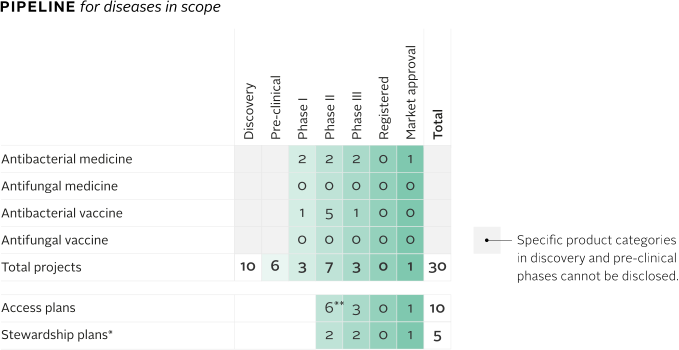
Largest pipeline targeting high and critical priority pathogens. GSK has by far the largest pipeline, with 30 projects targeting pathogens in scope. Among them, 1 antibacterial project – gepotidacin, indicated for uncomplicated urinary tract infections – received market approval within the period of analysis. (See figure on p. xx for GSK’s pipeline breakdown, including phases). Its vaccine pipeline (13) is larger and more diverse compared to other companies, targeting various pathogen groups, including Enterobacterales and Streptococcus pneumoniae. It is also the only company in scope developing vaccines for Salmonella and Shigella spp. GSK has the highest number of projects (23) addressing ‘high’ or ‘critical’ priority pathogens as defined by WHO. This includes projects targeting rifampicin-resistant Mycobacterium TB (critical), carbapenem-resistant Enterobacterales (critical), cephalosporin-resistant Neisseria gonorrhoeae (high) and vaccines to prevent Enterobacterales and Salmonella. GSK has 3 antibacterials in its pipeline classified as innovative, the second highest of any company: alpibectir, gepotidacin and ganfeborole, with each meeting at least 1 of WHO’s defined innovation criteria. For example, ganfeborole (GSK3036656), for the treatment of TB, meets all 4 defined criteria: it has no known cross-resistance, belongs to a new chemical class, and has both a new target and a new mode of action. GSK reports having an in-house discovery programme related to several early-stage projects aiming to tackle both critical and high-priority pathogens.
Above-average performance, with systematic but sometimes general approach to access planning. GSK has access plans for all its 10 late-stage projects assessed, including elements for registration, equitable pricing and licensing agreements. In general, access planning combines project-specific and more general company-wide approaches. The company is conducting clinical trials across LMICs, including projects on urogenital infection, investigational oral TB medicines in South Africa and vaccine studies in African countries. The company indicates that trial site selection is based on unmet medical need and its intent to file for registration in that market. GSK has stewardship plans to ensure appropriate use and applies this to all its late-stage medicine projects (5). Actions include engaging in partnerships to build surveillance networks, supporting diagnosis.
Responsible Manufacturing
Performs strongly. Reports a comprehensive environmental risk management strategy aimed at mitigating AMR risk at both its own and suppliers’ sites. It reports compliance with discharge limits for all antibacterial products manufactured at its own and its suppliers’ sites. GSK’s incorporation of AMR provisions in supplier contracts, and its hands-on approach to supporting suppliers’ wastewater management practices, is highlighted as a Best Practice in the Benchmark. GSK publicly discloses quantification methods and aggregated level of compliance across its supply chain.
Mitigates AMR risk at both its own and suppliers’ sites; reports 100% of antibacterials are compliant with discharge limits. GSK’s comprehensive environmental risk management strategy is based on the AMR Industry Alliance Antibiotic Manufacturing Standard (Industry Standard). It estimates antibacterial discharges at its own sites annually using mass balance; if PNECs are exceeded, chemical analysis is performed for verification and CAPAs are implemented.The company reports that 100% of its antibacterial products are compliant with PNECs in the receiving environment, where wastewater is already diluted, which means that AMR risks present in wastewater may not be fully captured. 16 of its products have received a BSI Kitemark™ for Minimised Risk of Antimicrobial Resistance Certification. GSK also requires its antibacterial suppliers to follow the Industry Standard, verifying estimations via chemical analysis. It conducts supplier audits every 3 years on average and has contractual provisions encompassing compliance with discharge limits. If PNECs are exceeded, GSK requests suppliers to implement CAPAs to ensure compliance. It reports that 100% of the antibacterial products manufactured by its suppliers are compliant with discharge limits in the receiving environment. GSK works with external waste treatment plants and reports requesting information from them (e.g. flow rates and operating parameters) for quantification of discharge levels. It also employs measures to treat wastewater prior to sending it to plants.
Publicly discloses comprehensive details on how it minimises the risk of AMR and ecological effects from antibacterial manufacturing; >99% of its antibacterials are compliant with limits. GSK publicly reports implementing the Industry Standard, quantifies discharge levels using mass balance, which it verifies by chemical analysis, as required, and achieves compliance with discharge limits at >99% of all its own sites and its key suppliers’ sites. The company does not publicly disclose audit results with the actual discharge levels of its own sites or its suppliers’ sites, nor the names and locations of its manufacturing sites for each manufactured antibacterial.
Appropriate Access & Stewardship
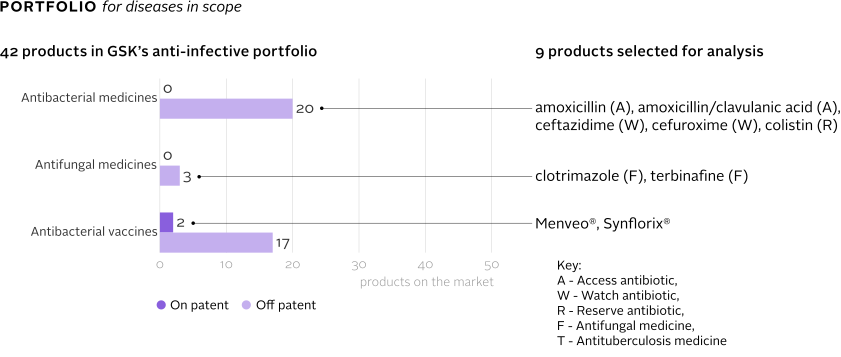
Performs well. Registers its off-patent medicines in more countries on average than peers and effectively implements access and stewardship strategies for most assessed off-patent medicines, as well as comprehensive access strategies for the two on-patent vaccines evaluated. Its transparent reporting of transfers of value to ensure appropriate use is highlighted as a Best Practice in the Benchmark. GSK’s approach to mitigate stockouts and shortages is comprehensive, and it engages in five multinational surveillance programmes, sharing aggregated data from three. However, GSK can increase its registrations for on-patent vaccines as it has fewer country registrations than peers.
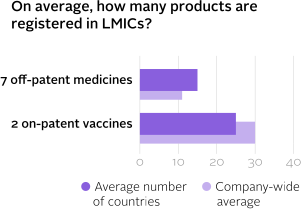
GSK registers its off-patent medicines more widely than its peers, although its vaccines are registered less extensively. GSK registers its off-patent medicines in 15 countries.* In many countries where it registers its off-patent medicines, it also registers paediatric formulations. For its off-patent Reserve antibiotic, colistin, there is no evidence of any registrations in countries in scope. The company’s 2 on-patent vaccines are registered in 25 countries, including 3 countries where the corresponding disease burden is high. GSK received WHO Prequalification (WHO PQ) for both of its vaccines.
*All numbers in this statement are expressed as an average of the products selected for analysis and refer to registrations in the 113 countries in scope for ‘access metrics’.
Above-average performance, with both access and stewardship strategies for 5 of 7 off-patent/generic products assessed. GSK’s strategies are primarily implemented in the private sector, the prevailing market in the countries where strategies are reported. However, for 2 products, GSK has participated and been awarded public tenders. In addition, GSK partners with local manufacturers in 2 countries in scope of the Benchmark to produce 2 products. For all 5 products, GSK reports monitoring access strategies through country-level sales or prescription figures and also implements stewardship strategies to ensure responsible promotion. Strategies for 3 products are more comprehensive and include surveillance activities. For example, both amoxicillin and amoxicillin/clavulanic acid are included in the Survey of Antibiotic Resistance (SOAR) programme in Pakistan. GSK shares this surveillance data directly with HCPs through in-person meetings and a dedicated website, the Pakistan Infection Index.
Above-average performance, with comprehensive access strategies for the 2 on-patent vaccines assessed. For its ACWY meningococcal vaccine Menveo®, GSK has been awarded the contract to be the sole supplier for the immunisation of adolescents in Brazil, where the National Immunisation Programme includes 2 vaccines against meningococcal meningitis: 1 for infants and 1 for adolescents. A technology transfer for Menveo® manufacturing is currently underway with 2 Brazilian institutions, enhancing local production and capacity building. GSK's 10-valent pneumococcal conjugate vaccine, Synflorix®, is supplied through pooled procurement mechanisms via Gavi/UNICEF and PAHO. In 2024, GSK implemented a price reduction of Synflorix® for the Gavi tender until the end of the contract in 2028. GSK also participates in WHO’s Humanitarian Mechanism, whereby Synflorix® is supplied at the reduced Gavi prices to countries facing humanitarian emergencies.
Strong efforts to mitigate stockouts/shortages. Strong reported evidence of systems to ensure product quality. GSK implements demand planning and data sharing through regular meetings with local health authorities in LDCs and LICs to address forecasting needs. It conducts 3-year forecasts with monthly market intelligence inputs, as well as annual long-term demand forecasting (up to 10 years), and shares plans with internal stakeholders in monthly sales and operations planning meetings. GSK maintains buffer stocks for both APIs and finished products for regional supply in at least 6 countries in scope of the Benchmark. Inventory levels are monitored with real-time data using just-in-time or hybrid inventory systems. It implements supplier diversification strategies for its critical antibacterial and antifungal medicines by establishing multiple manufacturing sites and sources critical raw materials from various suppliers. It mitigates substandard and falsified products by verifying suppliers through GMP audits and reporting cases to WHO and relevant authorities. It implements security features, such as serialised barcodes and tamper-evident packaging. In Pakistan, GSK works with governments and regulators to identify falsified medicine operations as an additional quality assurance step in a country with an evolving regulatory system.
Includes some elements to address appropriate use across its business practices. GSK does not decouple incentives for its sales agents from sales volume targets. Eligibility for participation in the sales incentive plan is contingent upon meeting criteria of ethical behaviour, compliance and product knowledge, as demonstrated by passing annual compliance and product knowledge assessments. Any additional details were disclosed under an NDA. Through its global public policy, GSK ensures all interactions with HCPs are ethical by specifying the legitimate need for such interactions and how to mitigate potential conflicts of interest. It also sets limits on transfers of value (ToVs) and ensures these are made at fair market value. GSK also voluntarily discloses information on ToVs on an individual level where this is permitted by law, and otherwise on an aggregated level. GSK transparently lists all countries where it discloses ToVs on its website. GSK applies its sales incentive plan and global policy to third parties working on its behalf.
GSK is active in 5 multinational surveillance programmes. GSK runs the multinational 'Survey of Antibiotic Resistance’ (SOAR) programme. SOAR is conducted in study cycles of approximately 2-3 years, covering 2 genera of bacteria, 15 antibacterial medicines and 12 countries in its latest cycle. The company has already shared raw data from 2 study cycles via the AMR Register, making the data available upon request, and commits to continue to do this when the upcoming SOAR study is completed. Additionally, GSK is involved in 4 multinational surveillance programmes. Aggregated data from 3 of these programmes was shared via poster abstracts or peer-reviewed journals during the period of analysis. The methods GSK uses to collect surveillance data for all 5 programmes are largely clear, including: the type of surveillance; where the analysis is conducted and which breakpoints are used; how deduplication is considered; and how participating healthcare facilities are selected, although public disclosure is limited.
