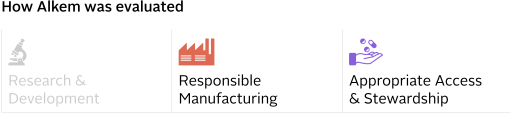
Performance in the 2026 Benchmark*
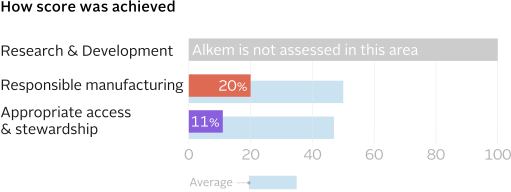
Weak performance. Alkem’s performance in Responsible Manufacturing is limited due to the absence of an AMR-specific environmental risk management strategy to ensure responsible manufacturing practices. It also has potential to strengthen performance in Appropriate Access & Stewardship as it publicly reports limited measures to ensure continuous supply of its products in LMICs and does not disclose any access or stewardship strategies across the products selected for analysis.
*For the 2026 AMR Benchmark, Alkem did not submit data.
Opportunities for Alkem
Expand appropriate access to its antibacterial and antifungal medicines. Alkem does not disclose any access strategies or provide evidence of registering any of its medicines in LMICs. The company can expand appropriate access to its products – for example, its Reserve antibiotic, colistin, indicated as a last-resort treatment for multidrug-resistant gram-negative infections – by expanding registrations and/or implementing appropriate access strategies in LMICs, prioritising countries with high unmet need.
Track product-level patient reach for off-patent antibacterial and antifungal drugs. Alkem does not disclose patient reach data for any of its assessed products. The company can improve in tracking patient reach – which is essential to enable measurement of appropriate access and support the responsible use of its medicines – by implementing a patient reach methodology and applying it across its entire portfolio, at both the product- and country-level.
Strengthen its governance of interactions with healthcare professionals. Alkem’s public policy governing interactions with healthcare professionals (HCPs) does not include specific provisions to ensure they remain ethical. Alkem can strengthen its governance, and thereby address appropriate use of its antimicrobials, by including specific provisions to ensure a legitimate need for such interactions; mitigate potential conflicts of interest – specifically between employees and HCPs; limit transfers of value and ensure these are made at fair market value.
Formalise and publicly disclose comprehensive environmental risk management strategy to mitigate AMR. Alkem publicly reports implementing general controls to minimise waste discharges, but not antibacterial-specific measures. As a first step, it can begin periodic wastewater sampling to accurately quantify antibacterial discharge, in line with the ‘stringent’ WHO guidance, and ensure compliance with discharge limits directly in wastewater for all its own and its suppliers’ sites. It can demonstrate progress by publicly reporting its antibacterial waste management practices, including compliance levels across its sites and suppliers’, and the quantification methods used.
Changes since November 2023 update report on previous Benchmark opportunities
Aside from examples covered within the 2026 AMR Benchmark report analysis, no notable updates can be reported for Alkem since the AMR Benchmark Opportunities: Company progress since 2021, which was published in 2023.
Sales & Operations
Therapeutic areas: Anti-Infectives, cardiovascular, dermatology, diabetes, gastroenterology, gynecology, neurology, pain and analgesics, respiratory diseases
Product categories: Consumer health products, generic medicines & biosimilars
Investments in AMR: No notable investments identified.
M&A news: None identified in the antibacterial and/or antifungal sectors.
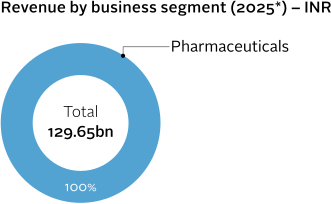
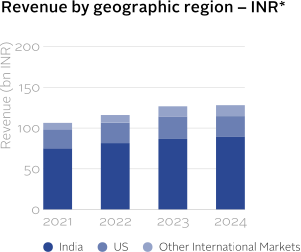
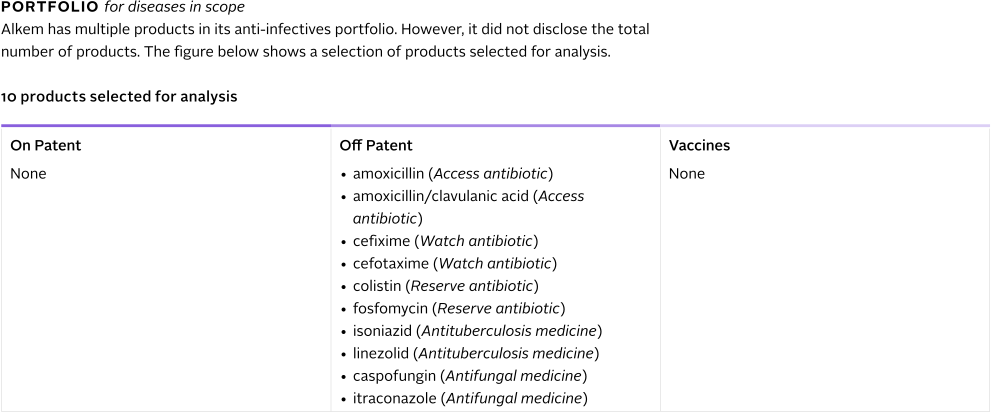
Sample of portfolio assessed by the Benchmark
Performance by Research Area
Responsible Manufacturing
Weak performance. Does not report an AMR-specific environmental risk management strategy at its own or suppliers’ sites. It publicly reports initiating antibacterial discharge quantification at one site, although periodic quantification is lacking. As such, Alkem does not report the level of compliance achieved across its supply chain.
Mitigates AMR risk through general environmental risk management practices; does not track antibacterials’ compliance with discharge limits. Alkem does not report, either publicly or to the Benchmark, an AMR-specific environmental risk management strategy, however, it publicly reports implementing ZLD technologies at 42% of its own sites. While no comprehensive strategy is in place, Alkem implements controls to minimise waste discharges and initiating a gap assessment with BSI Kitemark™ to assess antibacterial waste practices at 1 of its sites, including a CAPA plan. However, the company does not report periodically estimating antibacterial discharge at its own sites or at suppliers' sites. Therefore, it is unclear how many antibacterial products meet discharge limits at its own, or its suppliers’ sites. No information could be identified on whether Alkem engages with external waste treatment plants to minimise AMR risk from manufacturing.
Publicly discloses limited details of its AMR mitigation strategy and is not transparent about compliance with discharge limits. Alkem publicly reports having made initial steps towards AMR mitigation (quantification at 1 manufacturing site, CAPAs), but any concrete periodic quantification of discharge levels or compliance with PNECs at its own sites or its suppliers’ sites could not be identified. It therefore does not publicly disclose audit results with measured discharge levels. It does publicly disclose the city-level locations of its manufacturing sites (with 18 located in India and 2 in the US) and that 42% of its manufacturing sites have implemented ZLD, but it is unclear whether antibacterials are manufactured at these sites.
Appropriate Access & Stewardship
Weak performance. Performs poorly across the Appropriate Access and Stewardship Research Area, publicly reporting limited measures to mitigate stockouts and shortages and reporting GMP compliance only at its own sites. Its performance in stewardship can be improved, as it does not consider appropriate use across its business practices. Additionally, Alkem does not disclose, publicly or to the Benchmark, where it registers its products, nor does it report any access or stewardship strategies for the products assessed.
Alkem’s performance on product registrations remains inconclusive. Alkem does not disclose any registration data to the Benchmark. Based on public information, it is unclear if Alkem engages in any mechanism to facilitate registrations for the products selected for analysis.
Below-average performance, with no evidence of access and stewardship strategies for its off-patent/generic antibacterial and antifungal medicines. Alkem has not disclosed, either publicly or to the Benchmark, access and stewardship strategies for any of the 10 products assessed in this category.
Limited action to mitigate stockouts/shortages. Limited reported evidence of systems to ensure product quality. Alkem publicly reports implementing strategies to promote supplier diversity by sourcing from local suppliers and working with multiple upstream suppliers. It reports that 90% of its input materials for Indian sites are sourced locally. However, there is no disclosure on demand planning or forecasting models implemented, buffer stock strategies, or the inventory management system used. It mitigates substandard and falsified products by implementing security features, such as holograms and security strips, and reports that all its sites are GMP compliant. However, it is unclear how many of its suppliers' sites are GMP compliant, or whether additional quality measures are implemented in countries with evolving regulatory systems.
Does not address appropriate use across its business practices. Alkem does not report, either publicly or to the Benchmark, whether it deploys sales agents and, if applicable, whether it decouples its incentives from sales volume targets or whether incentives are also linked to other qualitative measures. Through its global public policy Alkem ensures that interactions with HCPs are ethical. However, it does not include specific provisions supporting the appropriate use of antibacterial and antifungal medicines. Alkem does not voluntarily disclose transfers of value publicly in countries where it is not mandated by law, or by other codes of practice. Alkem applies its public policy to third parties working on its behalf. However, it is unclear if this is also the case for its sales incentive plan.
