Merck & Co. commits to broadening access to HIV prevention in LMICs
27 July 2026
Local vaccine manufacturing has become a strategic priority for Africa in recent years. Growing vaccine demand, the continent’s high burden of vaccine-preventable diseases and shifts in development aid funding have reinforced the need for a more resilient and sustainable vaccine supply. Against this backdrop, local manufacturing is seen as a promising solution to enable broader availability of innovative vaccines, reduce dependence on external suppliers and strengthen preparedness for future health emergencies.
Successful vaccine manufacturing requires balancing disease burden, manufacturing feasibility and commercial viability. Based on these parameters, the Partnerships for African Vaccine Manufacturing (PAVM) identified 22 target diseases, to help guide manufacturers and build momentum towards strengthening local capacity.1 Of these, vaccines for 10 diseases have subsequently been prioritised for local manufacturing in Africa: cholera, Ebola, HPV, malaria, measles-rubella, meningococcus, pneumococcus, rotavirus, tuberculosis, and yellow fever.2
But the continent’s capacity is growing. Investment, regulatory progress and increasing demand guarantees are creating momentum for local manufacturing and a more supportive environment for expansion. As the number of AVMs rises and their capabilities strengthen, they are becoming better positioned to scale up production. Technology transfers contribute to accelerating this progress, supporting the development of fill-and-finish capacity in the near term, with the ultimate goal of expanding end-to-end manufacturing on the continent.
Technology transfers can close gaps in manufacturing capacity for Africa’s priority vaccines by enabling local production without requiring manufacturers to develop vaccines from scratch. Many of the priority vaccines are already produced by global manufacturers, creating opportunities for technology transfers to AVMs.
For vaccine innovators, leveraging existing AVM infrastructure for technology transfers offers access to growing vaccine markets while strengthening local manufacturing capacity, fortifying regional supply and improving availability of innovative vaccines.
Presently, manufacturing vaccines for any of the 10 priority vaccines remains limited on the continent (see Figure 2), despite many suitable vaccines in the portfolio of large research-based companies in the scope of the Access to Medicine Index (the Index). Six companies in the scope of the Index have 31 vaccines in their portfolios targeting one or more of the 10 priority diseases. Of these, only one, a meningococcal vaccine from Sanofi, is currently part of a technology transfer to an AVM.3 Despite this potential, most active technology transfer agreements in Africa have been led by Asian vaccine innovators outside the scope of the Index.
The fastest route to expand local production would be through a fill-and-finish technology transfer, where the capacity is most developed. However, the aim should be for fill-and-finish to be a stepping stone to further expansion into end-to-end manufacturing capabilities.
Recent investments are laying the foundation for end-to-end to expand and attract new technology partnerships. Manufacturers such as Biovac and VaxSen (the commercial subsidiary of Institut Pasteur de Dakar) have secured significant financing from development finance institutions to improve their capabilities and develop large-scale drug substance production.4-6 This progress creates an opportunity for technology originators to engage in end-to-end technology transfers, helping to de-risk partnerships and support the development of sustainable manufacturing on the continent.
These partnerships are already taking shape at Biovac, which is currently receiving an end-to-end technology transfer of an oral cholera vaccine from the International Vaccine Institute, alongside two fill-and-finish technology transfer partnerships with Sanofi. Following an initial transfer in 2020 (see Box-out), Sanofi expanded the partnership in 2024 to include a second vaccine (for polio) and additional late-stage formulation processes, reinforcing technology transfers as a scalable model for vaccine manufacturing in Africa.7
Recent developments are creating a more enabling environment for technology transfers and local vaccine manufacturing. Rising demand, stronger regulatory systems, new procurement mechanisms, growing commitment from global health stakeholders and increased investments from multilateral development banks are helping to reduce the barriers that have historically limited growth in the sector.
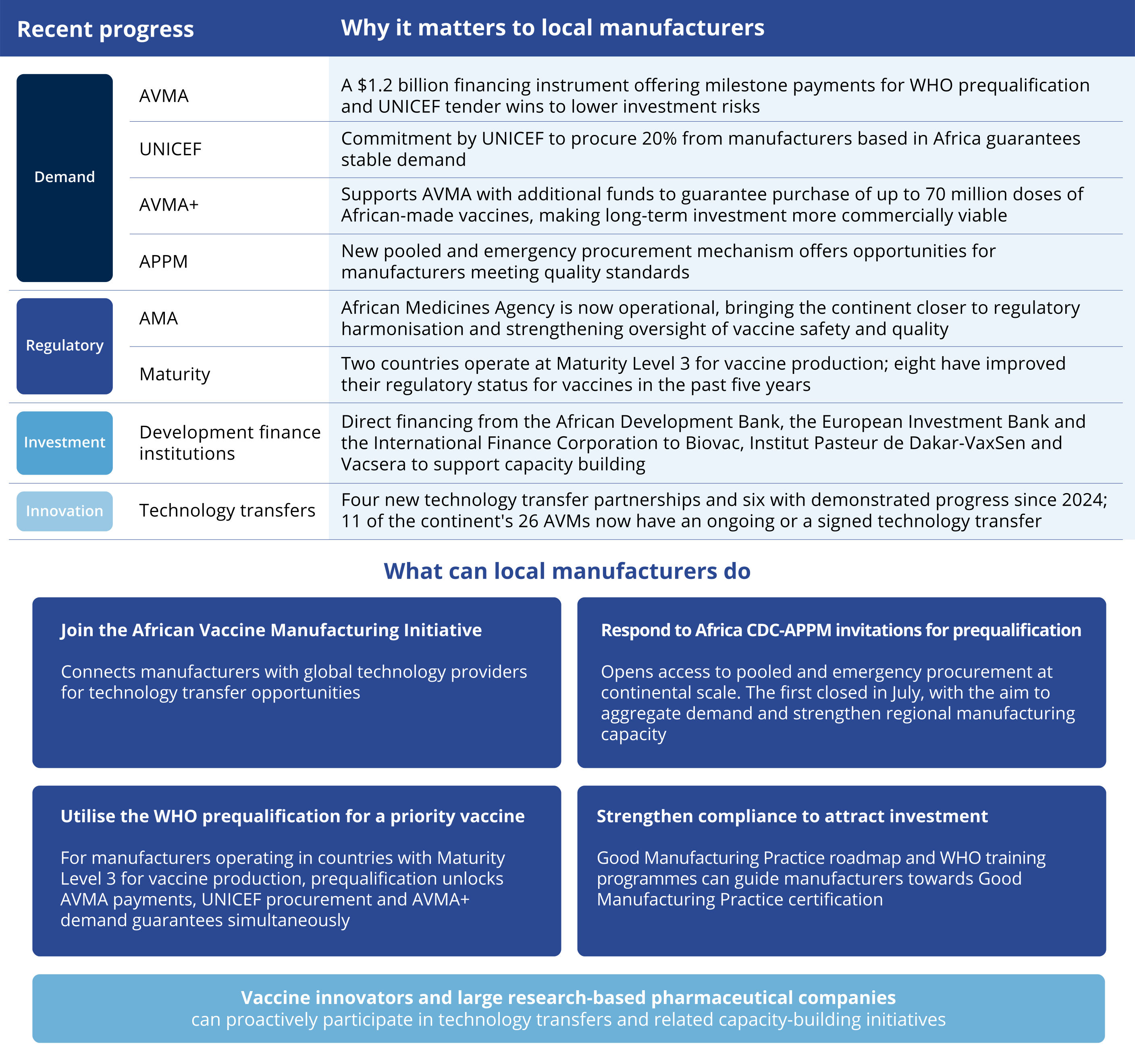
Regional vaccine manufacturing is an important component of building a more resilient and sustainable supply of innovative vaccines in Africa, especially amid shifts in development aid. The changing investment environment and growing political appetite across the continent, create an opportunity for vaccine innovators, African vaccine manufacturers and other stakeholders across the vaccine ecosystem to coordinate efforts and build on recent progress. This momentum can lead to a stronger vaccine manufacturing capacity on the continent and attract more technology transfers, for fill-and-finish, and, ultimately, end-to-end manufacturing.
* Data in this analysis is sourced from publicly available information; no company consultation was conducted.
1. Africa CDC. Partnerships for African Vaccine Manufacturing (PAVM) Framework for Action — Africa Health Knowledge Hub. 2022. Accessed August 14, 2026. https://khub.africacdc.org/records/resource/partnerships-for-african-vaccine-manufacturing-pavm-framework-for-action
2. Doua J, Ndembi N, Auerbach J, Kaseya J, Zumla A. Advancing local manufacturing capacities for vaccines within Africa – Opportunities, priorities and challenges. Vaccine. 2025;50:126829. doi:10.1016/J.VACCINE.2025.126829
3. Deux vaccins Sanofi seront produits par Marbio à Benslimane pour répondre aux besoins nationaux - Médias24 - Numéro un de l’information économique marocaine. Accessed August 14, 2026. https://medias24.com/2025/10/30/deux-vaccins-sanofi-seront-produits-au-maroc-pour-repondre-aux-besoins-nationaux/
4. IFC, EIB Group and European Commission back Biovac to build Africa’s first end-to-end multi-vaccine manufacturing site, advancing vaccine self-reliance. Accessed August 14, 2026. https://www.ifc.org/en/pressroom/2026/ifc-eib-group-and-european-commission-back-biovac
5. South Africa: African Development Bank and Biovac sign $15 million agreement to advance Africa’s first end-to-end cholera vaccine production. Accessed August 14, 2026. https://www.afdb.org/en/news-and-events/south-africa-african-development-bank-and-biovac-sign-15-million-agreement-advance-africas-first-end-end-cholera-vaccine-production-95738
6. Global Partners Invest $45 Million to Boost African Vaccine Production. Accessed August 14, 2026. https://www.afdb.org/en/news-and-events/press-releases/global-partners-invest-45-million-boost-african-vaccine-production-79715
7. Sanofi and Biovac partner to produce polio vaccines in Africa. Accessed August 14, 2026. https://www.pharmaceutical-technology.com/news/sanofi-biovac-polio-vaccines-africa/?cf-view
8. Biovac clinches R5.3bn state vaccine contract - Juta MedicalBrief. Accessed August 14, 2026. https://www.medicalbrief.co.za/biovac-clinches-r5-3bn-state-vaccine-contract/
9. Mogale M, Burnett RJ, Olivier D, Mphahlele J. Economic assessment of implementing Hexaxim® vaccine within the South African Expanded Programme on Immunisation (EPI-SA). International Journal of Infectious Diseases. 2014;21:430. doi:10.1016/j.ijid.2014.03.1307