
Performance in the 2026 Benchmark
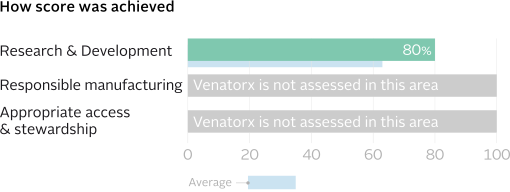
Performs strongly. Both of Venatorx’s pipeline candidates target ‘critical’ priority pathogens and the company demonstrates Best Practice by meeting at least one of WHO’s four innovation criteria for both of them. It stands out for its robust access and stewardship plan for its sole late-stage candidate, cefepime-taniborbactam, developed in partnership with GARDP, which addresses availability and supply barriers in LMICs.
For the 2026 AMR Benchmark, Venatorx declined to submit data. Regarding the partnership with GARDP on cefepime-taniborbactam, data was received from GARDP. After the period of analysis of the Benchmark, GARDP and Venatorx announced the termination of their collaboration agreement for this project.
Opportunities for Venatorx
Advance paediatric studies to strengthen access for future use in children Venatorx’s pipeline focuses mainly on multidrug-resistant Gram-negative pathogens and S. aureus, all classified as priority pathogens by WHO. It has a comprehensive access and stewardship plan in place for its late-stage candidate, Cefepime-taniborbactam (IV), through its partnership with the Global Antibiotic Research and Development Partnership (GARDP). It can build on this partnership to expand the development of cefepime–taniborbactam – which is on WHO’s Paediatric Drug Optimisation watch list for antibiotics – to advance paediatric studies, which could help close critical treatment gaps for future use in children.
Sales & Operations
Therapeutic areas: Anti-infectives
Financial stage: Private (Series C financing completed in April 2022)
Products on the market: None
Commercial partners: For the development and commercialisation of cefepime-taniborbactam, Venatorx has exclusive licensing agreements with Melinta Therapeutics for the US; Menarini Group for 96 countries across Europe, Latin America, Middle East, North Africa, Turkey and the Commonwealth of Independent States; Everest Medicines for 11 countries in Asia; and GARDP for 64 LMICs. Venatorx licensed the global rights of its clinical-stage oral antibiotic, ceftibuten-ledaborbactam, to Basilea in August 2025.
Funding partners: Venatorx receives funding from Abingworth, the AMR Action Fund, CARB-X, BARDA, BioAdvance, DTRA, Foresite Capital, NIAID, Verstant Ventures and Wellcome Trust.
Sample of pipeline assessed by the Benchmark*
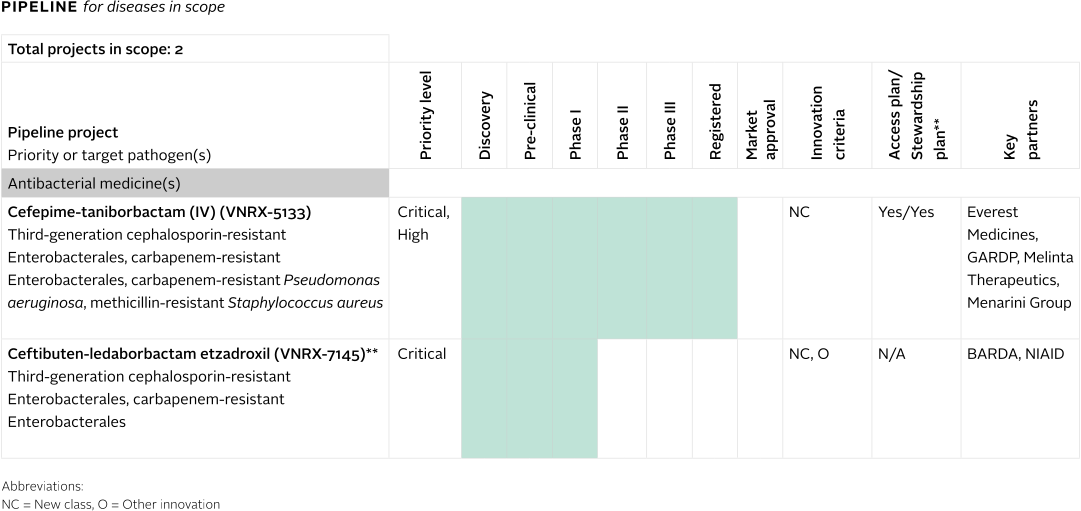
Pipeline for diseases in scope
*For the 2026 AMR Benchmark, Venatorx declined to submit data. Regarding the partnership with GARDP on cefepime-taniborbactam, data was received from GARDP. After the period of analysis of the Benchmark, GARDP and Venatorx announced the termination of their collaboration agreement for this project.
**During the period of analysis for the 2026 AMR Benchmark, Venatorx granted Basilea the global rights to ceftibutenledaborbactam etzadroxil. However, it was still assessed within Venatorx’s pipeline, as it was under Venatorx’s development during the analysis period.
Research & Development
Pipeline of antibacterial medicines targeting critical priority pathogens, with 2 innovative candidates. Venatorx has 2 pipeline projects targeting pathogens in scope, both of which are antibacterial medicines: ceftibuten-ledaborbactam Etzadroxil (VNRX-7145)**, currently in Phase I; and intravenous cefepime-taniborbactam (VNRX-5133), currently undergoing regulatory review for complicated urinary tract infections (cUTIs) and hospital-acquired/ventilator-associated bacterial pneumonia (HABP/VABP). (See figure above for Venatorx’s full pipeline breakdown, including drug development phases and disease targets). Both projects target multiple priority pathogens, including carbapenem-resistant Enterobacterales and cephalosporin-resistant Enterobacterales, which are classified as ‘critical’ priority pathogens. Additionally, both projects are considered innovative and meet 1 of WHO's 4 innovation criteria (new chemical class). Ceftibuten–ledaborbactam etzadroxil (VNRX-7145) also meets the Benchmark’s ‘other’ criterion, as the first oral treatment option with reliable activity against ESBL-producing Enterobacterales causing cUTIs. Venatorx did not report an active in-house discovery programme.
Comprehensive access and stewardship plan for its sole late-stage project through partnerships. Venatorx has an access plan for its late-stage candidate, cefepime-taniborbactam, which is currently undergoing regulatory review. The project is currently on hold pending additional regulatory data. The company has established licensing agreements for cefepime-taniborbactam for countries in scope of the Benchmark via partnerships with Everest Medicines for 11 Asian countries; GARDP for 64 LMICs; and Menarini for 96 Latin American and Middle Eastern countries. Through GARDP, countries with the highest burdens of carbapenem-resistant pathogens are prioritised. Clinical trials have taken place in 5 countries in scope of the Benchmark (Brazil, China, Mexico, Peru and Ukraine). Venatorx has a stewardship plan in place for cefepime-taniborbactam. Through GARDP, which holds exclusive commercialisation rights in 64 LMICs, it prioritises countries with the highest burdens of carbapenem-resistant pathogens for access to adult and paediatric formulations. Stewardship is integral to the GARDP partnership and includes approaches to ensure appropriate use and preserve effectiveness of cefepime-taniborbactam.
Active in 1 multinational AMR surveillance programme. While Venatorx is not assessed for its activities in AMR surveillance as an SME, new activities from its involvement with 1 AMR surveillance programme were identified during the period of analysis. The 'Global Evaluation of Antimicrobial Resistance via Surveillance' programme (GEARS), which was run by Venatorx until 2022, covered 9 genera of bacteria, 10 antibacterial medicines and 59 countries. Raw data from GEARS was shared via the AMR Register during the period of analysis, where it is now available upon request. The methods Venatorx used to collect surveillance data for GEARS are largely clear, including: the type of surveillance; where the analysis is conducted and which breakpoints are used; and how deduplication is considered.
**During the period of analysis for the 2026 AMR Benchmark, Venatorx granted Basilea the global rights to ceftibuten-ledaborbactam etzadroxil. However, it was still assessed within Venatorx’s pipeline, as it was under Venatorx’s development during the analysis period.
