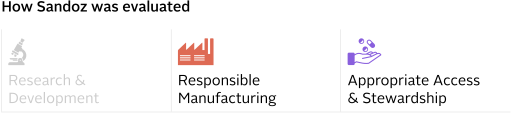
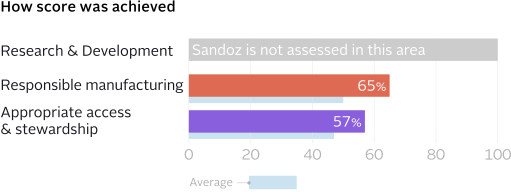
Performs well. Sandoz performs well in Responsible Manufacturing, reporting that all antibacterial products manufactured at its own and suppliers’ sites are compliant with discharge limits, and demonstrating Best Practice for taking a hands-on approach to its suppliers’ wastewater practices. It is mid-performing in Appropriate Access & Stewardship. Although it also demonstrates Best Practice for transparently publishing transfers of value in multiple countries, registers its products in more countries than other assessed generic medicine manufacturers and monitoring patient reach, it does not report product-specific access strategies.
Opportunities for Sandoz
Ensure appropriate access to its antibacterial and antifungal medicines. Sandoz registers its off-patent medicines in 12 LMICs, on average, and stands out for consistently registering its child-friendly formulations across the same countries. However, for five products there is a gap between the countries where they are registered and supplied. It can bridge this gap by ensuring its medicines are consistently supplied in countries where it registers its products, for example, in sub-Saharan African countries where the burden of AMR is disproportionally high.
Strengthen its governance of interactions with healthcare professionals. Through its public policy governing interactions with healthcare professionals, Sandoz already ensures that such interactions are based on a legitimate need and that transfers of value (ToVs) are made at fair market value. Sandoz can strengthen its policy, and thereby address appropriate use of its antimicrobials, by including provisions to specifically mitigate potential conflicts of interest between employees and healthcare professionals and by setting limits on ToVs.
Ensure compliance with discharge limits directly in wastewater and improve transparency on antibacterial waste management practices. Sandoz reports 100% compliance with discharge limits set in the receiving environment for its own and its suppliers’ products. To further safeguard AMR risk from antibacterial manufacturing, it can publicly report compliance with discharge limits directly in wastewater for all its own and suppliers’ products – a step beyond its current practice of setting discharge limits in receiving waters – in line with the ‘stringent’ WHO guidance.
Changes since November 2023 update report on previous Benchmark opportunities
Sandoz is newly assessed in the 2026 AMR Benchmark. The company was not evaluated in the 2021 AMR Benchmark or in AMR Benchmark Opportunities: Company progress since 2021, which was published in 2023. As such, there are no changes reported for Sandoz as there are no comparative progress updates to be made.
Sales & Operations
Therapeutic areas: Cardiovascular, central nervous system, dermatology, endocrinology, gastroenterology, infectious diseases, oncology, ophthalmology, respiratory diseases, rheumatology, women's health
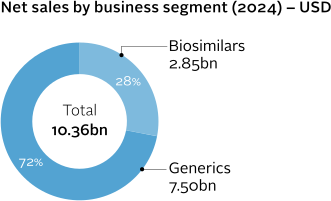
Product categories: Consumer health products, generic medicines & biosimilars, medical devices
Investments in AMR: In June 2024, Sandoz invested EUR 50mn to open a new facility for penicillins in Kundl, Austria. The new facility adds 20% to its current annual production capacity. The investment is the final part of a EUR 200mn total investment in its Kundl site to upgrade penicillin API manufacturing and increase the output of finished products.
M&A news: In April 2024, Sandoz’s Chinese business, including its portfolio of established products such as the antifungal voriconazole and its product pipeline, was acquired by Aspen Pharmacare Holdings.
Sample of portfolio assessed by the Benchmark
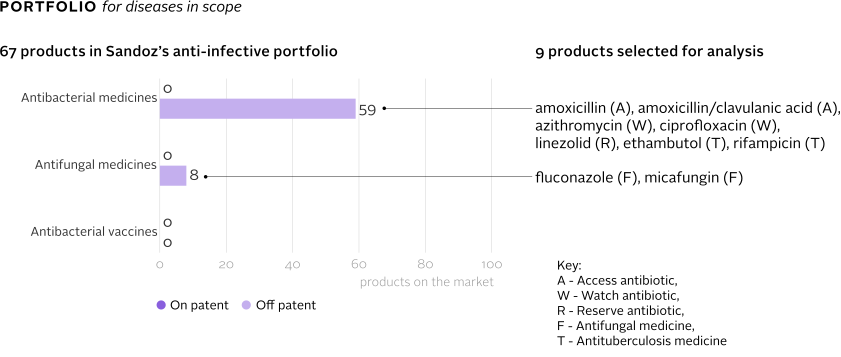
Performance by Research Area
Responsible Manufacturing
Performs well. Reports a comprehensive environmental risk management strategy aimed at mitigating AMR risk at both its own and suppliers’ sites. It reports compliance with discharge limits of all antibacterial products manufactured at both its own and suppliers’ sites. In addition, Sandoz’ incorporation of AMR provisions into supplier contracts, and its hands-on approach to supporting suppliers’ wastewater management practices, is highlighted as a Best Practice in the Benchmark. It publicly discloses the quantification methods implemented and the level of compliance achieved across its own sites, but not across its supplier sites.
Mitigates AMR risk at both its own sites and suppliers’ sites; reports 100% of antibacterials are compliant with discharge limits. Sandoz’s comprehensive environmental risk management is based on the AMR Industry Alliance Antibiotic Manufacturing Standard (Industry Standard). The company estimates antibacterial discharge levels annually at its own sites using mass balance estimation; if PNECs are exceeded, chemical analysis is performed for verification and CAPAs are implemented (e.g., introduction of additional pretreatment and cleaning steps). Sandoz reports that all its products manufactured at its own sites are compliant with discharge limits in the receiving environment, where wastewater is already diluted, which means that AMR risks present in wastewater may not be fully captured. 9 products received a BSI Kitemark™ for Minimised Risk of Antimicrobial Resistance Certification. Sandoz requires its antibacterial suppliers to follow the Industry Standard and introduced contractual provisions that encompass compliance with discharge limits. It reviews discharge levels through supplier audits and, if PNECs are exceeded, it requires suppliers to implement CAPAs (e.g., improving spill containment and cleaning practices). Sandoz reports that all its suppliers’ products comply with discharge limits in the receiving environment. The company employs conservative measures to ensure PNEC compliance of wastewater prior to sending it to plants and reports testing the wastewater of 1 plant biannually.
Publicly discloses basic details of its AMR mitigation strategy and is not publicly transparent about suppliers' compliance with discharge limits. Sandoz publicly reports implementing the Industry Standard and quantifying discharge levels using mass balance estimation, which is verified through chemical analysis. For both its own sites and its suppliers’ sites, it publicly reports conducting onsite audits on PNEC compliance but only discloses the number of own sites that are compliant. The audit results with the actual discharge levels are not publicly disclosed, nor are the number of its products complying with PNECs or the names and locations of manufacturing sites for each antibacterial product.
Appropriate Access & Stewardship
Mid-performing. Shows strong performance in ensuring continuous supply, as it has a comprehensive approach to mitigate stockouts and shortages. It also performs well by registering its products more widely compared to peers and using a standardised methodology for calculating patient reach across its portfolio. Its transparency in reporting transfers of value to ensure appropriate use is highlighted as a Best Practice in the Benchmark. However, Sandoz does not disclose whether it tailors access strategies to specific products or countries, reporting only general access strategies.
Sandoz registers its off-patent medicines more widely than its peers.
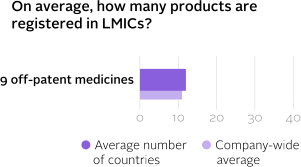
Sandoz registers its off-patent medicines in 12 countries.* In most countries where Sandoz registers its off-patent medicines, it also registers paediatric formulations. Its sole Reserve antibiotic, linezolid, is registered in a total of 2 countries. Sandoz does not report engaging in any mechanism to facilitate registrations for the products selected for analysis.
*All numbers in this statement are expressed as an average of the products selected for analysis and refer to registrations in the 113 countries in scope for ‘access metrics’.
Average performance, with general strategies to ensure access and stewardship for 9 off-patent/generic products assessed. Sandoz did not disclose whether it tailors strategies to expand access for specific products or countries. It does cite strategic partnerships as one of the key ways to expand access to its 9 products, including partnerships with Americares and Direct Relief to donate medicines to patients affected by humanitarian crises. 2 products – amoxicillin and azithromycin – have been donated to 30 and 16 LMICs, respectively. Sandoz has a standardised methodology to measure patient reach and reports the corresponding numbers at the country level for all 9 products. For 1 product, micafungin, Sandoz reports product-specific responsible promotion activities during its launch in the Philippines. However, for the 8 remaining products, Sandoz only reports a general portfolio-wide approach focused on responsible promotion and sales.
Strong efforts mitigate stockouts/shortages. Some reported evidence of systems to ensure product quality. Sandoz implements demand planning and data sharing by conducting 3-year forecasts with monthly updates, as well as annual long-term demand forecasting of up to 10 years. It receives real country-level demand forecasts and utilises public/private databases to provide supply forecasts of several weeks to authorities. It maintains buffer stock for its key APIs and drug products, but it is unclear whether an automated inventory system is implemented. It implements supplier diversification strategies for its key APIs and drug product, including dual sourcing, manufacturing line redundancies within the same factory and prioritising local sourcing. Sandoz mitigates substandard and falsified products by verifying suppliers through GMP audits and reporting incidents to relevant authorities. It reports that all its own and its suppliers’ sites are GMP compliant. However, it is unclear whether the company takes additional mitigation steps in countries with evolving regulatory systems.
Includes elements to address appropriate use across its business practices. While Sandoz’s sales incentive plan differs by country and sales role, it at least partly decouples incentives for its sales agents from sales targets in some countries. Sandoz does not report the proportion of variable pay it links to sales targets, nor does it specify any other measures that it links to incentives for any country. Sales targets can be set at the individual or on an aggregated level, or a combination of both. Through its global public policy, Sandoz ensures ethical interactions with HCPs, and for certain interactions it requires a defined legitimate need. It also ensures that transfers of value (ToVs) are made at fair market value. The full list of countries where Sandoz is disclosing ToVs can be easily accessed on its website. In Canada, Japan, Iceland and Ukraine, Sandoz voluntarily discloses information on ToVs. Sandoz applies its public policy to third parties working on its behalf. However, it is unclear if this is also the case for its sales incentive plan.
Active in 2 multi/national AMR surveillance programmes. While Sandoz is not assessed for its activities in AMR surveillance as a generic medicine manufacturer, its involvement in 2 AMR surveillance programmes was identified during the period of analysis. Since 2024, Sandoz has collaborated with JMI Laboratories for the 'International Surveillance Progamme for Micafungin', which runs under the umbrella of the 'SENTRY Antimicrobial Surveillance Programme', covering 1 genus of fungal pathogens, 1 antifungal medicine, and countries from North America, Europe, Latin America and Asia-Pacific regions. Aggregated data will be published as part of the ongoing data sharing via SENTRY's website. In addition, Sandoz funds the KOROUN study, which conducts national surveillance of bacterial infections in Poland. Aggregated data from this programme can be accessed via journal articles and on the programme's website. The methods used to collect surveillance data for the ‘International Surveillance Programme for Micafungin’ are in line with SENTRY methods and are therefore largely clear. The methods used for KOROUN are only partially clear.
