Performance in the 2024 Index
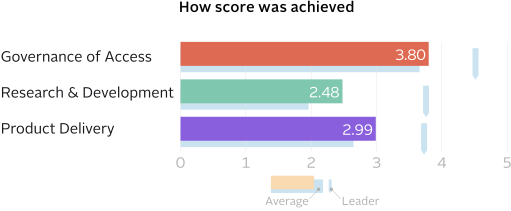
8th place. Pfizer performs well overall. It demonstrates Best Practice in research and development (R&D) access planning for its maternal group B Streptococcus (GBS) vaccine. Performance in Governance of Access is strengthened by systematic patient reach measurement. In Product Delivery, it is a middle-performing company: although it has comprehensive access strategies for some products, gaps remain in outcome reporting.
Opportunities for Pfizer
Ensure all late-stage communicable disease candidates have comprehensive access plans. Pfizer has access plans for fewer than 50% of its communicable disease projects. It can extend comprehensive plans across the communicable disease pipeline, addressing availability, affordability and sustainable supply in low- and middle-income countries (LMICs). Building on the comprehensive access planning demonstrated for its investigational GBS vaccine, developed with grant support from the Gates Foundation, Pfizer can apply similar approaches to other communicable disease projects.
Continue to scale access to RSV vaccine (Abrysvo®) in high-burden countries. Pfizer has expanded access to its RSV vaccine (Abrysvo®), including through the Pan American Health Organization Revolving Fund and by increasing registration to 22 countries in scope. Following World Health Organization (WHO) prequalification of the multidose presentation, making it eligible for Gavi support, Pfizer can continue to expand access in other high-burden countries, such as those in sub-Saharan Africa and South Asia, including through supranational procurement and/or its An Accord for a Healthier World (the Accord).
Build on existing breast cancer access strategies as new products emerge from the pipeline. Pfizer demonstrates comprehensive access strategies for its breast cancer medicine palbociclib (Ibrance®) across country income classifications and is expanding access to breast cancer treatment in Kenya through the Accord, including substantially reduced prices for selected cancer medicines. Building on these approaches, it can scale access to existing breast cancer products and strengthen access planning for late-stage pipeline candidates, including atirmociclib and prifetrastat, by broadening plans beyond availability measures and extending them to more countries with high unmet need.
Refine goal setting and outcome reporting for the Accord. Pfizer launched the Accord strategy in 2022 to close the health equity gap for 1.2 billion people living in 45 LMICs. To better assess progress, it can set time-bound, measurable patient reach targets. Since 2024, it has publicly disclosed its aggregate number of patients reached through the Accord. To further drive accountability and demonstrate progress, it can publicly report disaggregated patient reach numbers by product, therapeutic area and country.
Changes since the 2024 Index
• Provided USD 25mn in grants to support breast cancer initiatives in Rwanda, Ghana, Tanzania, Kenya and Ethiopia, focused on community-based solutions and health system strengthening.
• Expanded the Accord by signing bilateral Accord agreements with 13 additional countries, bringing the total number to 21 countries, enabling access to Pfizer medicines and vaccines for which it holds global rights on a not-for-profit basis and supporting efforts to address health system barriers.
• Reported expanded patient reach through the Accord with cumulative numbers increasing from approximately 200,000 to more than 1m, while increasing supply to more than 70 products and 750,000 units (up from 27 products and 200,000 units in 2024).
• Partnered with Argentina's Sinergium Biotech and PAHO to manufacture its PCV20 (Prevnar 20®) in Argentina. The collaboration aims to expand access to the vaccine in the Americas at competitive prices through PAHO’s Regional Revolving Funds for Access to Vaccines.
• In March 2025, received WHO prequalification for its maternal RSV vaccine (Abrysvo®) to protect infants. Gavi subsequently commenced the design phase of a new maternal vaccine programme targeting RSV burden in LMICs.
• Partnered with Brazil’s Butantan Institute through a Productive Development Partnership to expand access to its RSV vaccine (Abrysvo®) for pregnant people. The collaboration includes delivery of 1.8mn vaccine doses through Brazil’s public health system and technology transfer to enable local production of up to 8mn doses annually.
Therapeutic areas: Anti-infectives, inflammation & immunology, internal medicine, oncology, rare diseases and vaccines
Product categories: Biosimilars, generics, innovative medicines, vaccines
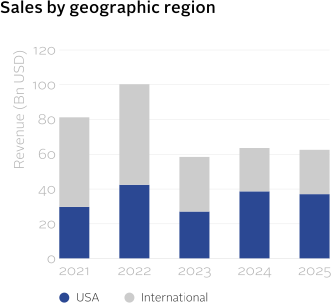
M&A news: In 2025, Pfizer acquired Metsera for up to USD 10bn. Between 2024 and 2026, Pfizer divested its stakes in ViiV Healthcare to Shionogi for USD 1.875bn and in Haleon for GBP 2.5bn.
Revenue by segment (2025) – in USD | |
Biopharmaceutical products | 61.20 bn |
Other | 1.38 bn |
Total | 62.58 bn |
Sample of pipeline and portfolio assessed by the Index
PIPELINE for diseases in scope
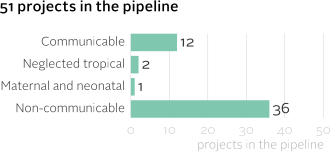
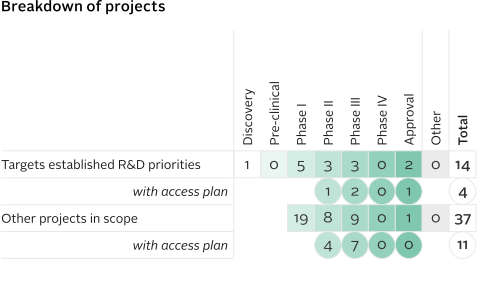
Pfizer has 51 R&D projects in scope, 14 of which target priority diseases, including lower respiratory infections (5) and other prioritised antibacterial-resistant infections (4). The remaining 37 R&D projects target other diseases in scope, including cancer (31) and cardiovascular diseases (2). Of its 51 R&D projects, 26 are in late-stage development, with evidence of access planning for 58% (15/26) of these.
PORTFOLIO as selected for analysis by the Index
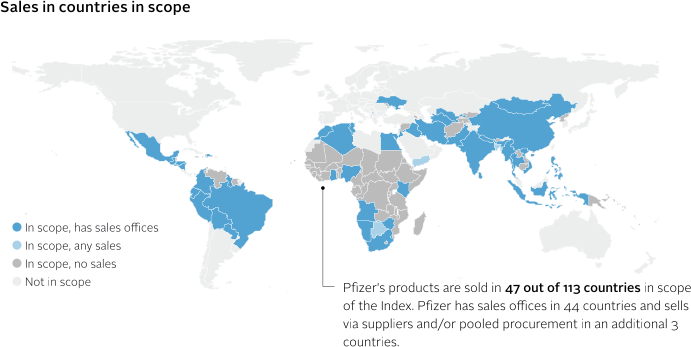
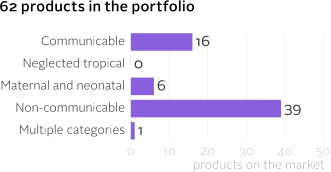
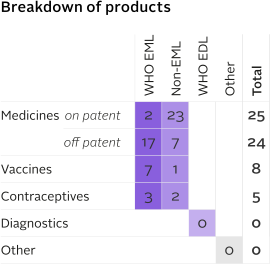
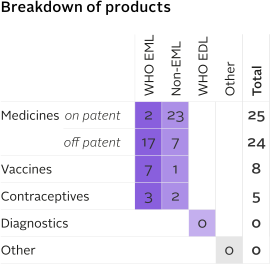
Pfizer has 62 products in scope, including 49 medicines and 8 vaccines; 29 are on the WHO EML. Overall, 33 are on patent. Most medicines target NCDs, such as cancer (27) and cardiovascular diseases (4). Medicines for communicable diseases include treatments for lower respiratory infections (2), TB (3) and 2 for both lower respiratory and enteric infections. Its maternal and neonatal products include 5 contraceptive methods and 1 maternal haemorrhage medicine. Its vaccines target meningitis (4), lower respiratory infections (3) and coronaviral diseases (1).
Performance breakdown
Governance of Access
10th place. Pfizer is a middle-performing company in Governance of Access, supported by clear board-level accountability for access to medicine and robust controls against non-compliant or corrupt conduct. It applies a systematic, company-wide approach to measuring patient reach, publicly disclosing its methodology. Through the Accord, it commits to expanding access across 45 LMICs but does not have a measurable patient reach target.
Has clear board-level accountability for access to medicine via its Governance Committee. This committee oversees access-related strategies and reviews related matters at least annually. Pfizer incentivises senior executives and in-country managers to support access to medicine. The CEO also has access-related incentives linked to Purpose Blueprint goals, including improving access through partnerships. Pfizer provides training, awareness-raising or guidance on the access-to-medicine strategy and activities at least annually.
Shows strong commitment to responsible sales and promotional practices. Pfizer sets individual-level sales targets that are derived from higher-level targets (e.g. country and business unit levels) and incentives are not solely based on sales volume. Sales representatives are also incentivised by non-sales components (e.g., manager feedback and policy and training adherence). It has a global policy on ensuring ethical interactions with healthcare professionals. It declares that transfers of value to healthcare professionals (e.g., payments for consulting) are made at fair market value. It publicly discloses information on such payments in countries in scope if required by law or local regulation.
Has a robust set of controls to promote ethical conduct and mitigate risk to ensure that governance efforts are not undermined by non-compliant or corrupt activities. Pfizer performs strongly in this respect. It has policies to mitigate non-compliance risks, including processes to ensure third-party compliance with company standards, fraud-specific risk assessments and region or country risk-based assessments. It has an ethical decision-making framework for employees and provides related training every 2 years. No breaches in countries in scope were found in the period of analysis.
Publicly supports the Doha Declaration on TRIPS and Public Health. However, it expresses reservations on some provisions of TRIPS flexibilities, namely compulsory licensing. Pfizer states that compulsory licensing may be appropriate to use in national health emergencies after exhausting all other options and if the problem is truly urgent.
Performs well in its approach to measuring and reporting on patient reach. Pfizer applies a systematic, company-wide approach across its full portfolio and all markets where it supplies products. It publicly discloses the underlying equation, metrics, assumptions and limitations. It has set an access target through the Accord, but this does not constitute a time-bound or measurable patient reach target. Patient reach is reported publicly at least annually as an aggregate global figure across products, vaccines and access channels.
Research and Development
6th place. Pfizer performs well in R&D, with an average-sized priority disease pipeline and a large pipeline addressing other diseases. Access planning is mixed: one priority asset has a comprehensive plan, while others are more limited in depth and breadth. It does not disclose disaggregated R&D investment data publicly or to global health organisations.
Average-sized pipeline addressing priority diseases in scope, compared to peers, consisting of 14 projects, with access plans identified for 50% (4/8) of its late-stage R&D projects. Access planning performance is mixed. For its GBS vaccine candidate, developed with grant support from the Gates Foundation, the access plan is comprehensive in depth and breadth, including equitable pricing plans, demand and supply planning and registration preparation. However, access plans for other assets are more limited in depth and breadth.
Large-sized pipeline addressing other diseases in scope, compared to peers, consisting of 37 projects, with access plans identified for 61% (11/18) of its late-stage R&D projects. These projects target diseases not currently identified as priorities by global health stakeholders. Access plans focus mainly on registration preparation and post-trial access, with limited geographic scope.
Does not publicly disclose R&D investment data disaggregated by disease category, product type or phase of development. Furthermore, Pfizer does not disclose disaggregated R&D investment data to global health organisations.
All 3 R&D capacity-building initiatives included for analysis meet all Good Practice Standards (GPS). One example is a consortium that seeks to identify novel genetic drivers of cancer disparities in African and Caribbean populations, with partners in 6 LMICs in scope, expanding from 5 in the previous reporting period.
Product Delivery
11th place. Pfizer is a middle-performing company in Product Delivery. It registers newer products in more countries than peers on average, but in fewer countries with the highest burden of disease. It performs well in the access strategies implemented for the products assessed; however, reporting on the outcomes of these strategies is more limited. Not all of the company’s capacity-building initiatives meet all GPS. Pfizer’s inclusive business model, the Accord, covers several products and countries in scope; however, limited country-specific information is publicly disclosed.
Registers newer products* in more countries (14) than its peers on average. However, Pfizer’s products are, on average, registered in fewer countries with the highest burden of disease (1) compared to peers. For 4/10 of the products assessed, there is evidence of registration in LICs. Its PCV (Prevnar 20®) is its most widely registered product, totalling 30 countries in scope, an increase of 22 countries since the previous Index. It reports engaging in mechanisms to facilitate registration, including the WHO SRA-CRP.
*Products that received their first marketing authorisation within the last 5 years.
Supplies 5 products via supranational agreements, with some information on outcomes. Pfizer supplies 3 vaccines and 2 contraceptives via procurers such as Gavi/UNICEF and the United Nations Population Fund. For 3 of the 5, it demonstrates access strategies for at least 1 non-eligible country. For example, it supplies its contraceptive (Sayana Press®) to a country outside of the supranational agreement via multiple strategies. For all strategies assessed, it shares outcomes (e.g., doses supplied) of the supranational agreements, but outcome reporting for strategies implemented in non-eligible countries is less comprehensive.
Comprehensive access strategies for its HCP-administered products in most countries, but limited information on outcomes. For 3 of the 4 products assessed, Pfizer has access strategies in place in UMICs and LMICs, and it shows evidence of considering different segments of the population and different payers' ability to pay. For its 4th product, PCV (Prevnar 20®), it provides an access strategy example in an LMIC, while working with PAHO on a transition plan in a UMIC. During the period of analysis, 1 product was supplied in a low-income country (LIC) at a not-for-profit price as part of the Accord, but limited details are provided to the Index. Pfizer reports health system strengthening initiatives in UMICs and LMICs for 2 of the 4 products. It shares information on patient reach or volumes sold for some of the strategies assessed, but overall outcomes data for the strategies is limited.
Access strategies for its self-administered products vary in comprehensiveness, with some information on outcomes. For 3 of the 5 products assessed, Pfizer has access strategies in place in all 3 country income classifications (UMIC, LMIC, LIC). UMIC and LMIC strategies vary based on country context, but different payers' ability to pay is taken into consideration. The 3 products, all oncology, are supplied in LICs via the Accord on a not-for-profit basis. For most country examples, it implements additional strategies to support affordability and access, such as patient assistance/patient support programmes for all 5 products in all LMIC examples. Outcomes, including patient reach numbers, are tracked and reported for 4 of the 5 products in both UMICs and LMICs, while no outcomes data is reported for the LIC examples.
Publicly commits not to enforce patents on any products in LDCs.
Publicly discloses product patent status for countries in scope. Pfizer publicly discloses patent information for small molecules in scope via the Pat-INFORMED database, including information such as filing date, grant number, grant date and jurisdiction.
1 non-exclusive voluntary licensing (NEVL) agreement for an on-patent compound. Pfizer has 1 NEVL for the on-patent COVID-19 treatment nirmatrelvir, signed in 2021. The licence contains access-oriented clauses and covers a broad geographic scope.
3 of the 4 manufacturing capacity-building initiatives included for analysis meet all GPS. For example, Pfizer is transferring technology for the formulation, fill and finish and packaging of respiratory syncytial virus vaccine to Brazilian Instituto Butantan. Pfizer is supporting the partner in meeting GMP and EHS standards.
2 of the 4 supply chain capacity-building initiatives included for analysis meet all GPS. For example, Pfizer partners with Zipline and governments in sub-Saharan Africa to use drone technology to overcome last-mile delivery challenges, ensuring reliable access to vaccines, blood and essential medicines in remote communities.
2 of the 5 health system strengthening initiatives included for analysis meet all GPS. For example, through the BEAT Breast Cancer Program in Tanzania, Pfizer aims to improve early detection of breast cancer by increasing community awareness, integrating screening into primary healthcare and ensuring timely referral and treatment.
No evidence of new or existing IP-sharing agreements that meet the inclusion criteria.
Publicly commits to continuing its long-term donation programme to support the elimination of trachoma. Pfizer commits to donating azithromycin (Zithromax®) through 2030. This programme is active in 22 countries in scope.
Fulfils all 3 mechanisms to ensure continuous supply in LMICs and is involved in local manufacturing at its own sites in countries in scope and demonstrates involvement in technology transfers (TTs). These TTs are designed to improve patient access, with ongoing support to the manufacturer. Pfizer operates its own manufacturing sites in 8 countries in scope.
Has a policy for reporting substandard and falsified medicines in countries in scope. Pfizer reports cases to national or local regulatory authorities but does not specify reporting timeframes. It reports that it follows locally mandated reporting requirements and timeframes. It does not provide evidence of shortened reporting timeframes for cases that only require visual inspection for confirmation.
Has 1 inclusive business model that meets inclusion criteria. The Accord covers 144** products in 45 LMICs. The Accord has publicly disclosed access goals but does not have a measurable or time-bound patient reach target. Pfizer via the Accord aims to close the health equity gap for 1.2bn people in 45 LMICs. Progress is evidenced by the Accord, which cumulatively reached 1m patients in 2026 since launch in 2022. However, country-level implementation progress across its activities and initiatives (e.g., patients reached disaggregated by country) is not publicly disclosed.
** There are additional products included in the Pfizer Accord listing that are not in the scope of the 2026 Index analysis.