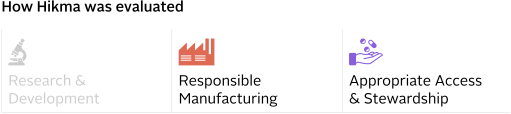
Performance in the 2026 Benchmark
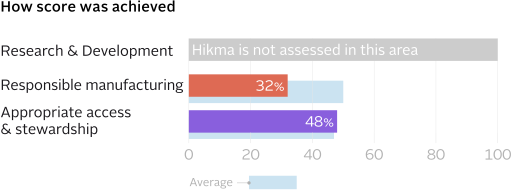
Low-performing. Hikma has opportunities to improve in Responsible Manufacturing as it does not report an AMR-specific environmental risk management strategy to ensure responsible manufacturing practices or the level of compliance with discharge limits achieved at its own sites. It also has potential to strengthen performance in Appropriate Access & Stewardship, where it shows mixed efforts. Although, it performs well in appropriate access strategies and monitoring patient reach for off-patent products, it could improve by making its stewardship approach more consistent and expanding registrations, as its products are registered in fewer countries than other assessed generic medicine manufacturers.
Opportunities for Hikma
Expand registrations to its off-patent antibacterial and antifungal medicines across the MENA region. Hikma has a strong presence in the Middle East and North Africa (MENA) region, which the company can utilise to further expand access to antimicrobial medicines across the region. Hikma performs well in its appropriate access strategies for off-patent antibacterial and antifungal medicines but only registers them in 4 LMICs on average. It can register its products more consistently across the MENA region and continue to also register child-friendly registrations in those same countries.
Strengthen stewardship strategies for on-patent antibiotics. Hikma has two on-patent Reserve antibiotics in its portfolio: meropenem-vaborbactam (Vabomere ®) and oritavancin (Orbactiv®). Both are indicated for serious infections caused by resistant bacteria and are especially important given the high incidence of drug-resistance in the MENA region. However, currently, Hikma’s stewardship strategies for the products lack depth and only report engaging in responsible business practice activities. Hikma can strengthen its stewardship strategies by engaging in surveillance and ensuring the availability of supportive diagnostics, to ensure these products stay effective for as long as possible.
Formalise comprehensive environmental risk management strategy to mitigate AMR and improve transparency on antibacterial waste management practices. Hikma reports implementing general controls to minimise waste discharges, but not antibacterial-specific measures. As a first step, it can begin periodic wastewater sampling to accurately quantify antibacterial discharge, in line with the ‘stringent’ WHO guidance, and ensure compliance with discharge limits directly in wastewater for all its own and its suppliers’ sites. It can demonstrate progress by publicly reporting its antibacterial waste management practices, including compliance levels across its sites and suppliers’, and the quantification methods used.
Changes since November 2023 update report on previous Benchmark opportunities
Hikma is newly assessed in the 2026 AMR Benchmark. The company was not evaluated in the 2021 AMR Benchmark or in AMR Benchmark Opportunities: Company progress since 2021, which was published in 2023. As such, there are no changes reported for Hikma as there are no comparative progress updates to be made.
Sales & Operations
Therapeutic areas: Anti-infectives, cardiovascular, central nervous system, diabetes, gastrointestinal, respiratory diseases, oncology, and others
Product categories: Generic medicines & biosimilars, innovative medicines (in-licensed)
Investments in AMR: No notable investments identified.
M&A news: In September 2024, Hikma acquired Xellia Pharmaceuticals’ US finished dosage form business and related assets, including its anti-infective products, such as the ready-to use formulation, Vanco Ready® (vancomycin), launched in 2019.
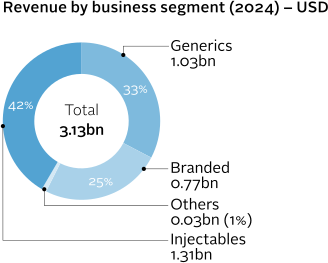
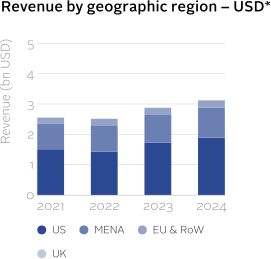
*From 2023 onwards, Hikma started including Canada in North America's revenue (previously in Europe and RoW). Here the categories have been kept as they were previously, and continued to include Canada in RoW (Canada revenue - 2024: $24M; 2023: $23M; 2022: $18M).
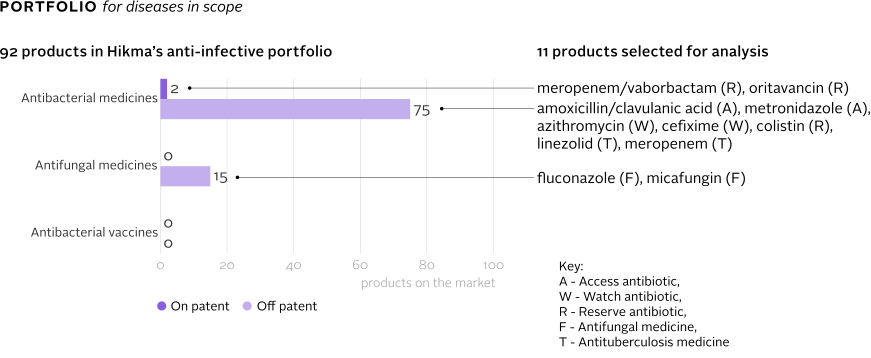
Sample of portfolio assessed by the Benchmark
Performance by Research Area
Responsible Manufacturing
Low-performing. Does not report an AMR-specific environmental risk management strategy at its own sites. For its own sites, it does not report periodically quantifying antibacterial discharge levels. For its suppliers, AMR-mitigation strategies and the level of compliance achieved are reported.
Reports a general environmental risk management strategy, without a specific aim to limit AMR. Hikma does not report implementing waste treatment practices specifically aimed at reducing AMR risk from antibacterial discharge at its own sites. It reports adopting wastewater quality limits in alignment with World Bank Group guidelines, but these practices do not explicitly address antibacterial discharge or AMR-specific risks. Equally, the company does not report estimating antibacterial discharge at its own sites or assessing levels against PNECs. Therefore, it is unclear how many antibacterial products comply with discharge limits at its own sites. While Hikma does not specifically require suppliers to implement antibacterial waste practices, it does report that some of its suppliers have practices in place. For example, its amoxicillin suppliers conduct monthly sampling at all sites and estimate discharge levels in line with the AMR Industry Alliance Antibiotic Manufacturing Standard and are compliant with PNECs. All its other antibacterial suppliers implement ZLD systems. However, the company does not include AMR provisions in its supplier contracts. No information could be identified on whether Hikma works with external waste treatment plants to minimise AMR risk from manufacturing.
No publicly available information on environmental risk management to mitigate AMR. Hikma does not publicly report quantification of antibacterial discharge levels at its own sites, or its suppliers’ sites, and therefore does not publicly disclose audit results, measured discharge levels, or the names and locations of manufacturing sites for each antibacterial product.
Appropriate Access & Stewardship
Low-performing. Performs well in implementing appropriate access strategies for all products assessed and using a standardised methodology for calculating patient reach across its off-patent portfolio. However, its product-specific stewardship efforts are limited and only implemented for its on-patent medicines. Hikma’s performance regarding stewardship is inconsistent, as appropriate use is considered in its sales practices, but not across its business practices. It has an opportunity to expand registrations, as it registers its products in less countries on average compared to peers.
Hikma registers its on- and off-patent medicines in fewer countries than its peers.
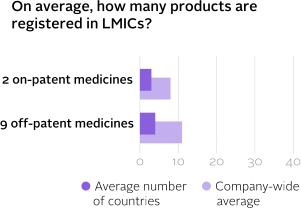
Hikma registers its on-patent medicines in 3 countries* and its off-patent medicines in 4 countries. In many countries where Hikma registers its off-patent medicines, it also registers paediatric formulations. Its on- and off-patent Reserve antibiotics and medicines targeting MDR-TB are registered in 3 countries, with 1 product (linezolid) being registered in a total of 1 country with a corresponding high disease burden (Iraq). Hikma does not report engaging in any mechanism to facilitate registrations for the products selected for analysis.
*All numbers in this statement are expressed as an average of the products selected for analysis and refer to registrations in the 113 countries in scope for ‘access metrics’. Hikma has a sales presence in 18 of these countries although, globally, it sells its products in 56 countries.
Average performance, with access strategies reported and monitored for 2 on-patent products assessed, but limited stewardship activities. Both products assessed, 2 Reserve antibiotics, are available only in the private market in Jordan. For oritavancin (Orbactiv®), Hikma provides a 35% discount on the list price and is also working on its inclusion in army hospitals, which cover more than 25% of the population. The company monitors the performance of its strategies by tracking the number of vials supplied to hospitals each month, and by monitoring pharmacies’ stock availability and the number of patients actively receiving treatment. Hikma reports the number of vials supplied for both products during the period of analysis. However, considering that both products are Reserve antibiotics, the company shows limited stewardship efforts, only implementing responsible promotion strategies.
Above-average performance, implementing and monitoring access strategies for all 9 off-patent/generic products assessed, but no evidence of engaging in stewardship activities. Hikma has access strategies for all 9 products assessed, but 8 are only available in the private sectors of the country examples analysed, and limited details are provided. For one product, amoxicillin/clavulanic acid, Hikma is the sole supplier in Jordan’s national tender, making the company responsible for providing the product to most of the population covered by public insurance. The company shows consistent efforts in monitoring its strategies by applying a standardised methodology to calculate patient reach, and reporting the units sold or patients reached during the period of analysis for all 9 products. However, Hikma does not demonstrate any evidence of implementing stewardship strategies for any of the 9 products.
Strong efforts to mitigate stockouts/shortages. Some reported evidence of systems to ensure product quality. Hikma implements demand planning and data sharing through a monthly rolling forecast with a 24-month horizon and creates a 5-year business plan for each product. However, it is unclear whether the company shares this information with relevant internal or external stakeholders. Hikma reports implementing an automated inventory management system and implementing buffer stock strategies tailored to each product, based on its value and demand predictability. It also reports implementing strategies to promote supplier diversity by sourcing its APIs from multiple upstream suppliers, with 59-60% of spending going to local suppliers in the MENA region. It mitigates substandard and falsified products by verifying suppliers through GMP audits, reports incidents to relevant authorities and implements security features, such as serialised barcodes, track-and-trace systems and smart labels. However, it does not disclose any additional quality measures implemented in countries with evolving regulatory systems.
Includes elements to address appropriate use in its sales practices, but not in its public policy. Hikma partly decouples incentives for its sales agents from sales volume targets, and targets are set at the individual level. Hikma does not report the proportion of variable pay it links to sales volume targets, nor does it specify any other measures that it links to incentives. Through its global public policy, Hikma ensures that interactions with HCPs are ethical. However, it does not include specific provisions supporting the appropriate use of antibacterial and antifungal medicines. While Hikma abides by disclosure requirements, it does not voluntarily disclose transfers of value publicly in countries where it is not mandated to by law, or by other codes of practice. Hikma applies its public policy to third parties working on its behalf. However, it is unclear if this is also the case for its sales incentive plan.