Performance in the 2026 Benchmark
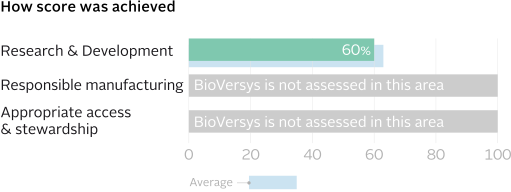
Performs well. All three of BioVersys’ pipeline candidates target ‘high’ or ‘critical’ priority pathogens. It demonstrates Best Practice for innovation, with both clinical-stage candidates classified as innovative. One meets one of WHO’s four innovation criteria; the other meets the Benchmark’s ‘other’ innovation criterion, which assesses real-world utility in LMICs, due to its novel indication and formulation targeting a ‘critical’ priority pathogen. However, BioVersys can strengthen its access and stewardship planning, as it does not yet have plans in place for its late-stage projects, although clinical trials for one project are underway in LMICs, with plans to expand trials for another.
Opportunities for BioVersys
Work with partners and utilise existing guidance to develop access and stewardship plans. BioVersys’ pipeline focuses on medicines targeting critical- and high-priority drug-resistant pathogens, specifically carbapenem-resistant A. baumannii (CRAB), M. tuberculosis, and S. aureus (including MRSA). BioVersys has not yet developed access and stewardship plans for either of its late-stage projects. When it develops access and stewardship plans, it can utilise the Stewardship & Access Plan (SAP) Development Guide and look for partners to strengthen its approach. For example, for its project BV100, targeting CRAB, currently in Phase III development, it can focus on regions with high A. baumannii resistance with limited alternative treatment options.
Sales & Operations
Therapeutic areas: Anti-infectives
Financial stage: Public (IPO completed in February 2025)
Products on the market: None
Commercial partners: BioVersys collaborates with Shionogi on the BV500 programme for non-tuberculous mycobacterial infections, aiming to develop novel ansamycin-based treatments. Additionally, the company has expanded its strategic partnership with GSK to advance the clinical development of alpibectir for tuberculosis, including both pulmonary and meningitis indications.
Funding partners: BioVersys has received funding from the AMR Action Fund, CARB-X, CF AMR Syndicate, Cystic Fibrosis Trust, EDCTP, GIBF, GSK, the IMI2 Joint Undertaking, LifeArc and the Wellcome Trust to support the development of its antibacterial pipeline.
Sample of pipeline assessed by the Benchmark
Pipeline for diseases in scope
Research & Development
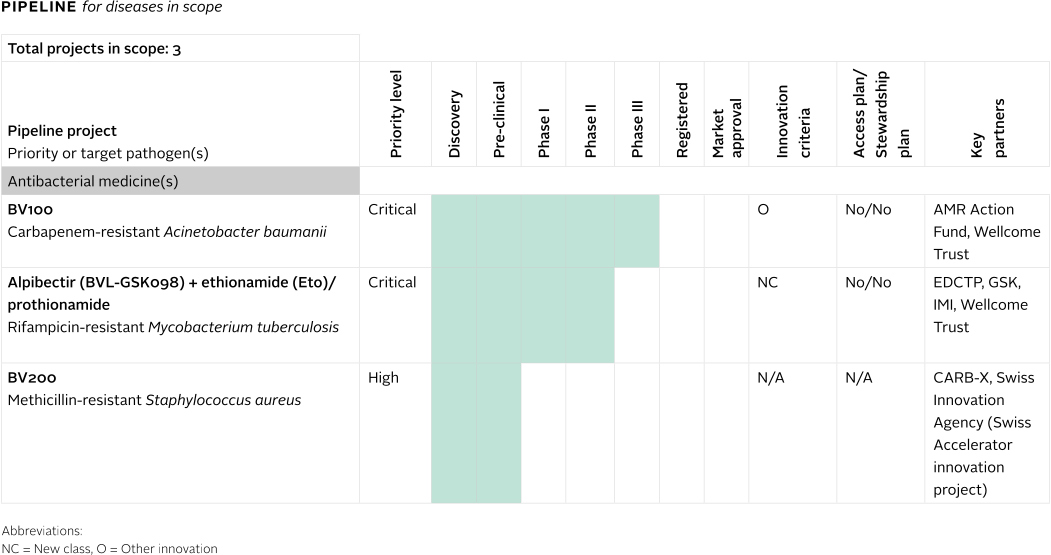
Pipeline of antibacterial medicines, including 2 innovative candidates in clinical development. BioVersys has 3 projects in its pipeline targeting pathogens in scope. All 3 are antibacterial medicines that target pathogens classified as ‘high’ or ‘critical’ on WHO’s bacterial priority pathogen list: BV200 for methicillin-resistant Staphylococcus aureus (MRSA), alpibectir for multidrug-resistant Mycobacterium TB and BV100 for carbapenem-resistant Acinetobacter baumannii (CRAB). (See figure above for BioVersys’ full pipeline breakdown including drug development phases). Two projects are considered innovative. Alpibectir meets 1 of WHO’s 4 innovation criteria, as it belongs to a novel chemical class. In addition, BV-100 – although derived from an existing antibiotic – meets the Benchmark’s ‘other’ innovative criterion due to its novel intravenous formulation and its development for a new indication targeting a critical-priority, resistant pathogen. BioVersys has an in-house discovery programme focused on highly resistant bacterial infections.
No evidence of access and stewardship planning. BioVersys has not yet developed access or stewardship plans for either of its late-stage projects (BV100 and alpibectir). Clinical trials for alpibectir – which is being developed in collaboration with GSK and the UNITE4TB consortium – are ongoing in South Africa. In addition, it plans to expand BV-100 trials to multiple countries in Southeast Asia through the ADVANCE-ID clinical trial network, targeting settings with very high levels of drug-resistant infections. However, beyond this no clear plans for access plans were identified.
